Ward-Thomas Museum


Charles S. Thomas Story
Ward — Thomas
Museum
Home of the Niles Historical Society
503 Brown Street Niles, Ohio 44446
Click here to become a Niles Historical Society Member or to renew your membership
Click on any photograph to view a larger image, click on image again to zoom into photograph.
|
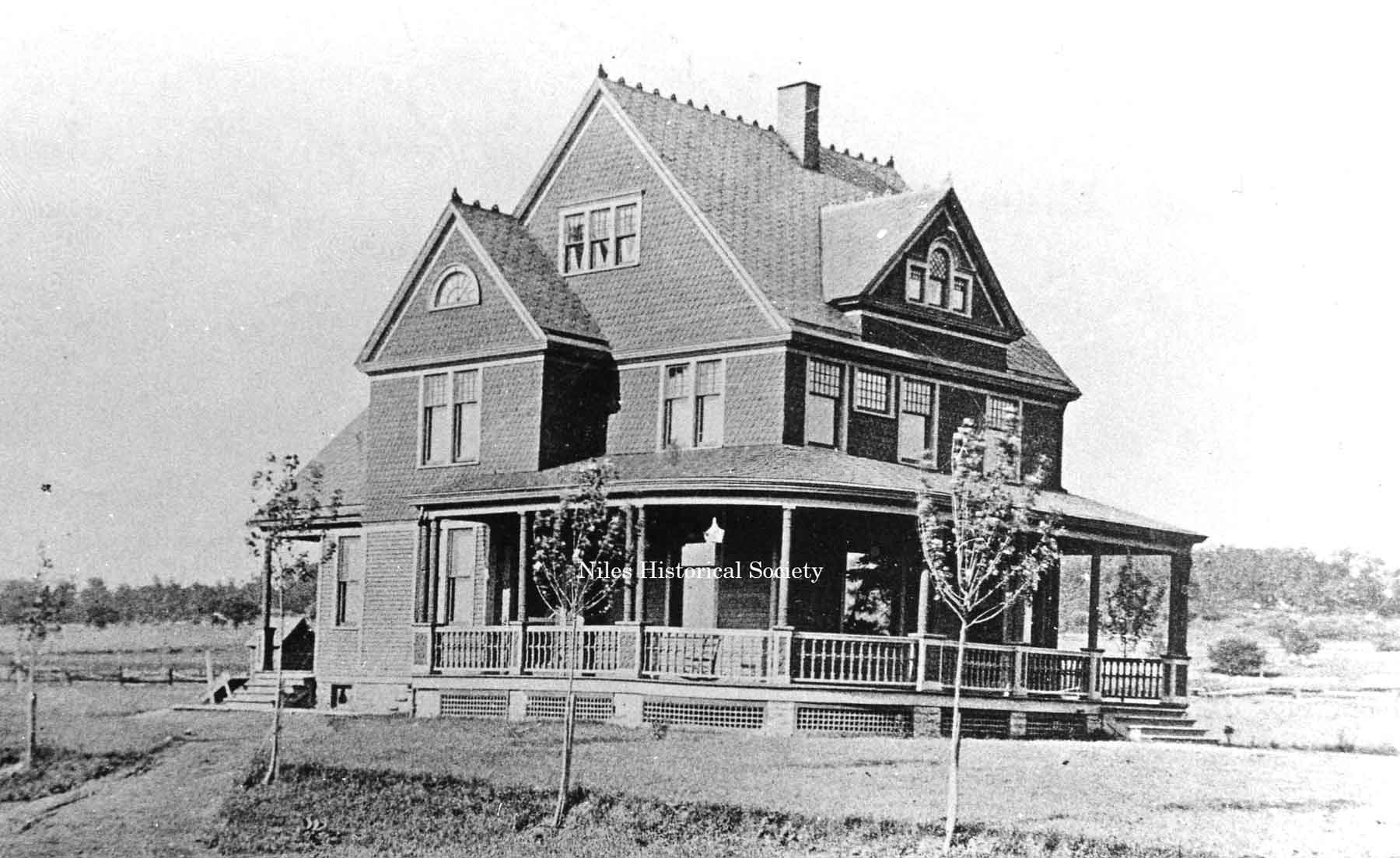
706 Robbins Avenue, ca 1905.
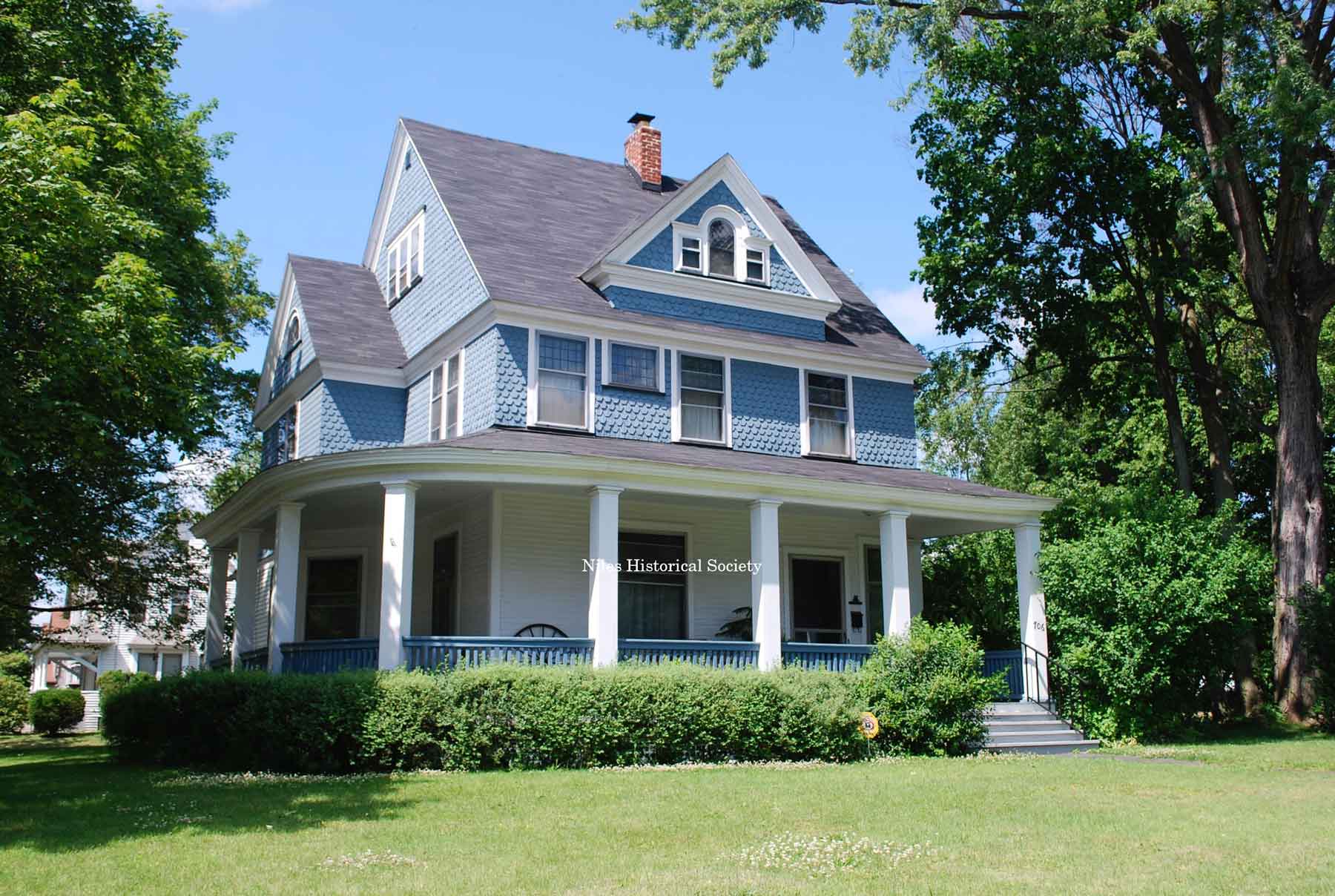
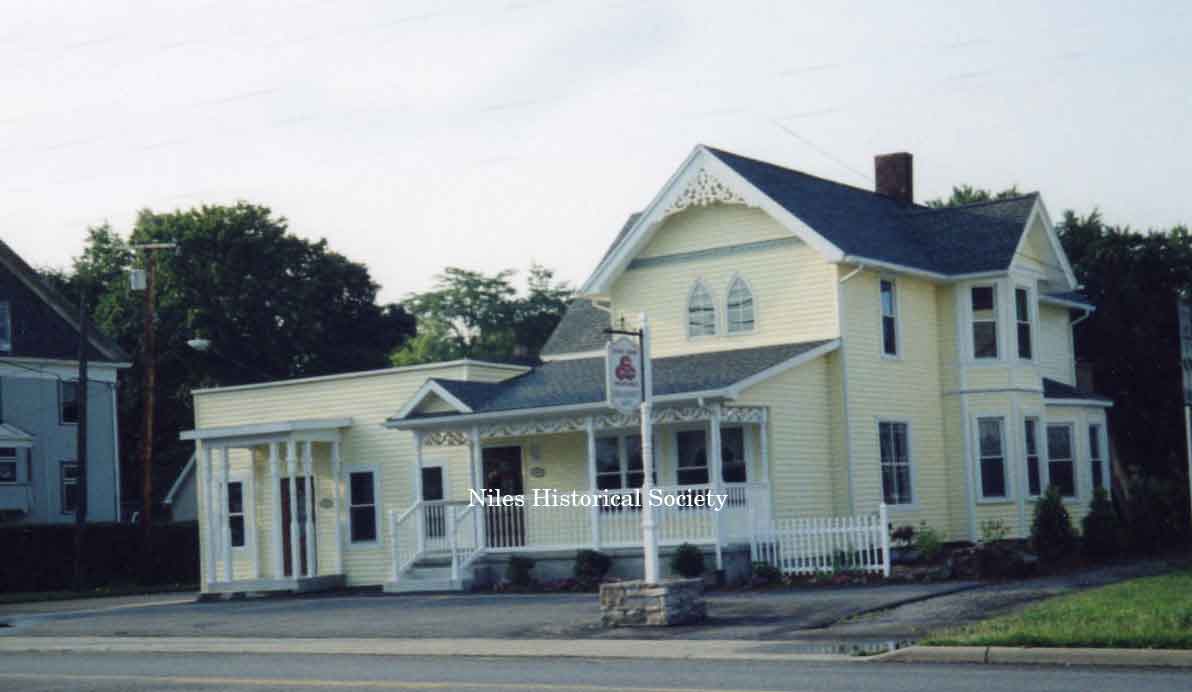
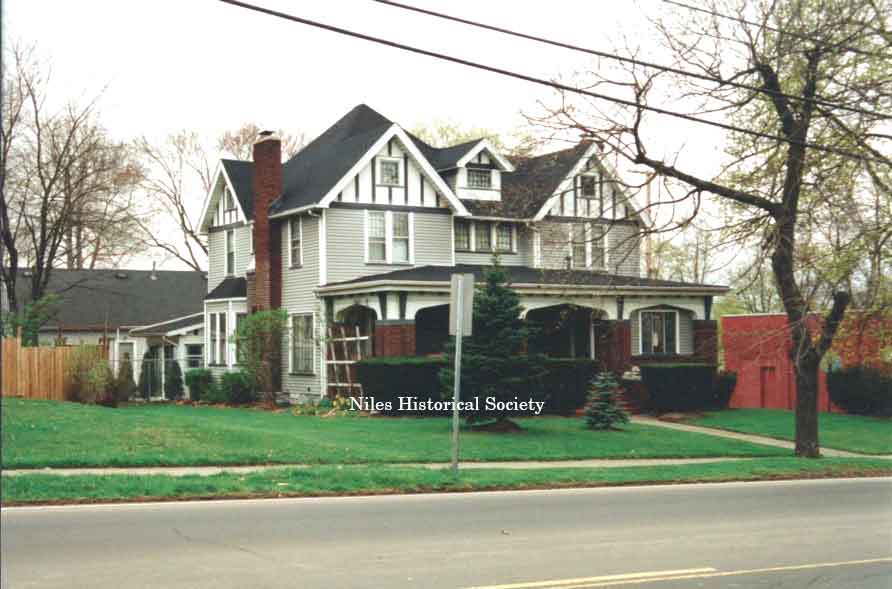
Pictured below are the present–day houses the Thomas family resided in Niles.
|
Charles
Samuel Thomas. Prominent Niles, Ohio Industrialist and civic
leader from 1903 to 1937. “My grandparents, Charles Samuel and Helen Struthers Thomas, along with my mother, Marion Struthers Thomas (age 5), and Mrs. Thomas’ mother, Marian McClane Struthers (Mrs. William Duff Struthers) moved to Niles from Struthers, Ohio in 1903 before July when their son Dudley was born. After they moved into the currently blue house at 706 Robbins Avenue, Mrs. Struthers died that November. By 1908, the Thomas family were living in the house at 639 Robbins Avenue (formerly James Dairy, Korner Dairy and the State Farm Insurance office) – by then the family included Mrs. Thomas’ divorced sister, Mrs. Marion Summers and her two children, Myron and Helen (they had arrived in the household in 1906 which probably led to moving to a larger house). By 1910, however the family numbering three adults, four children plus a maid were living at 903 Robbins Avenue where they remained until moving to Youngstown in 1917”. – Bill Deibel |
|
|
706 Robbins Avenue, 2013. |
639 Robbins Avenue, 2013. |
903 Robbins Avenue, 2013. |
|
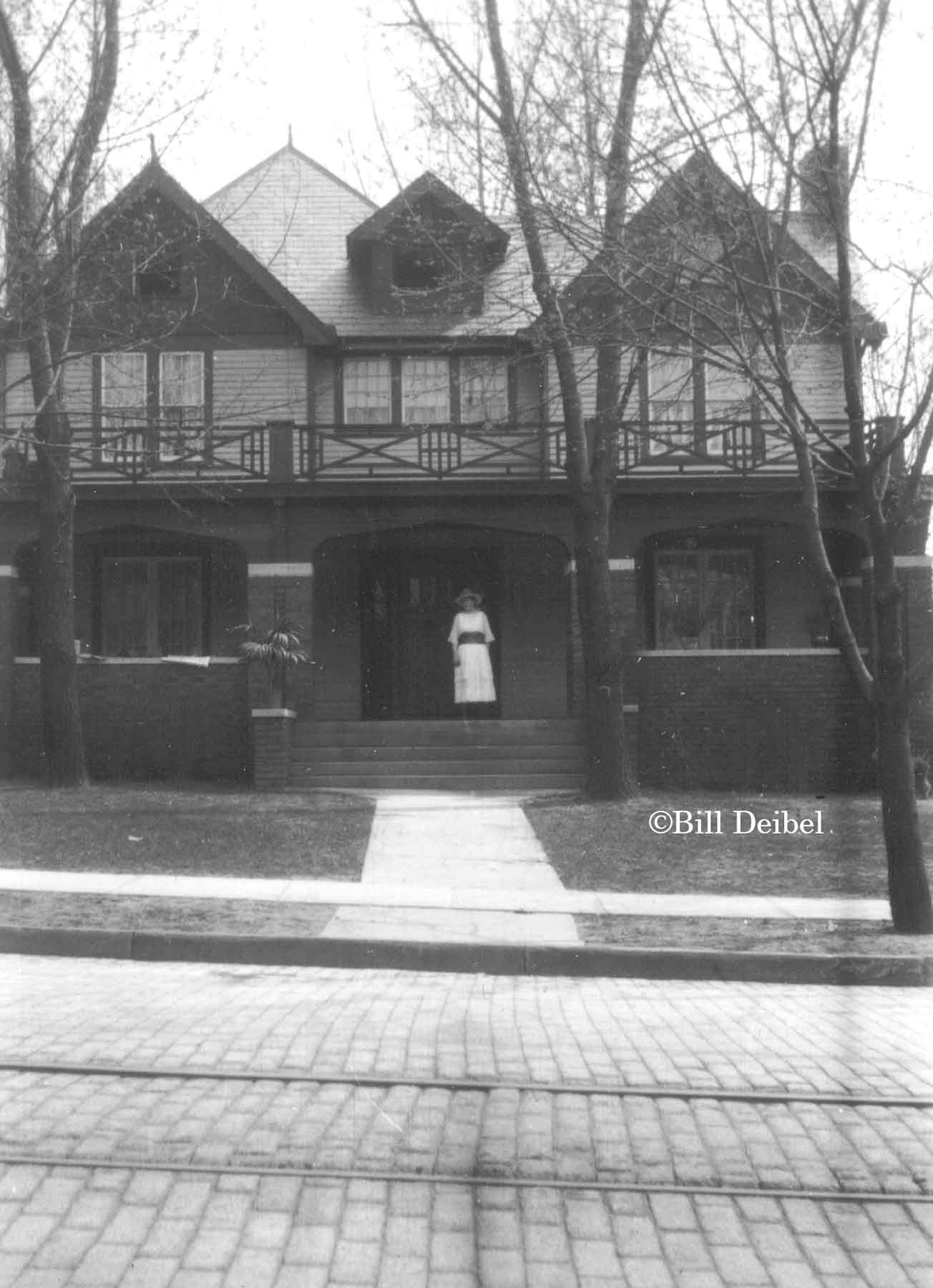
Marion standing on porch at 903 Robbins.
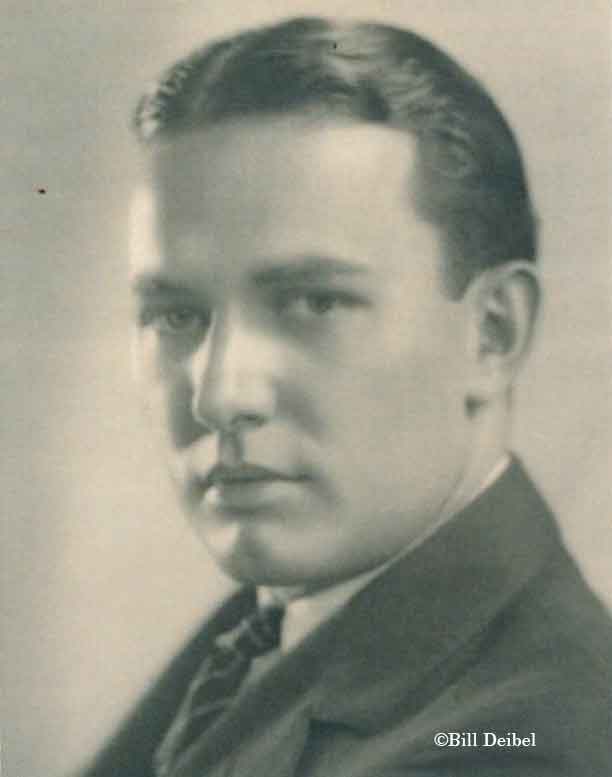
Cyril P. "Cy" Deibel in 1920.
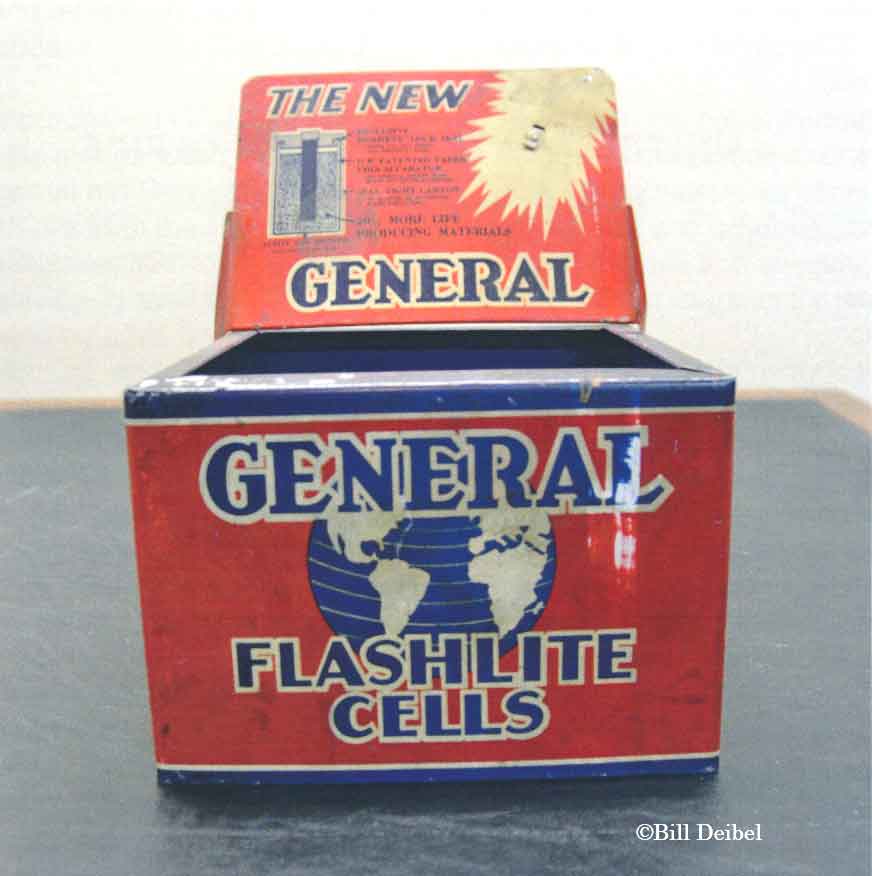
Counter display and dispenser for the new GENERAL brand flashlight cells introduced following company name change to General Dry Batteries, Inc. in October 1926. |
On July 17, 1919 under a one-inch-tall banner headline "CHARLES SAMUEL THOMAS HEADS NEW MILL", The Niles Daily News states “Charles Thomas, formerly principal owner of the Deforest Steel works (sic) at Niles, and still the general managerat Republic Steel, is to invest about $2,000,000 in a sheet and tinplate works at New Castle. … Mr. Thomas agreed to continue as general manager until Republic ‘got on its feet.’ … It is reported that the works will go on a site near Mahoningtown, where there is an abundant water supply and excellent main line railroad facilities.” The paper goes on to say “…tentative plans have been made for a 12-mill plant” intended to employ 4,000 men. (The writer can only imagine the reaction of the Republic owners who in buying Deforest enabled Charles Samuel Thomas to build a new plant to directly compete with them about 25 miles away). Startling as this announcement may seem, nothing ever came of this plan. Charles Samuel Thomas, after building the Falcon mill would not have had $2,000,000.00 of his own money available and may not have been able to get any bankers to back him in this venture. On the other hand, he may just have been “messing” with the Republic folks’ heads. More importantly in 1919 Charles S. Thomas, along with his good friend (but no relation to William Aubrey Thomas) W.A. Thomas – a very prominent Niles steel–industry leader, and Charles Deibel of Youngstown invested $25,000 each in The Twin Dry Cell Battery Company in Cleveland giving the three of them about 85% of the stock. This was done at the instigation of Charles Deibel’s son, Cyril P. "Cy" Deibel and Cy’s fiancée Marion Thomas, Charles Samuel Thomas’ daughter. Cy Deibel was a 1916 graduate of Ohio State University with a degree in General Engineering. Born in Youngstown, Ohio, Mr. Deibel was the son of Charles and Agnes Siebold Deibel. He received his B.S. in Engineering degree from Ohio State University in 1916, and for the next two years served as a sergeant at Base Hospital 31 with the American forces in France. After returning from France and being discharged from the U.S. Army in 1919, he had moved to Cleveland and taken a job with theTwin Dry Cell Battery Company which had only been started in 1917 and incorporated the following year. The company had yet to make a profit. After this investment Cy Deibel was made President and General Manager of Twin Dry Cell. 1919 was indeed a very busy year for Charles Samuel Thomas. He also served as a director for the Idora Park Amusement Company and president of Chemical Enterprises, Inc. He was a member of the Veterans of Foreign Wars. Cyril Paul Deibel, president of General Dry Batteries, died at the age of 50. He leaves a widow, the former Marion Struthers Thomas. |
|
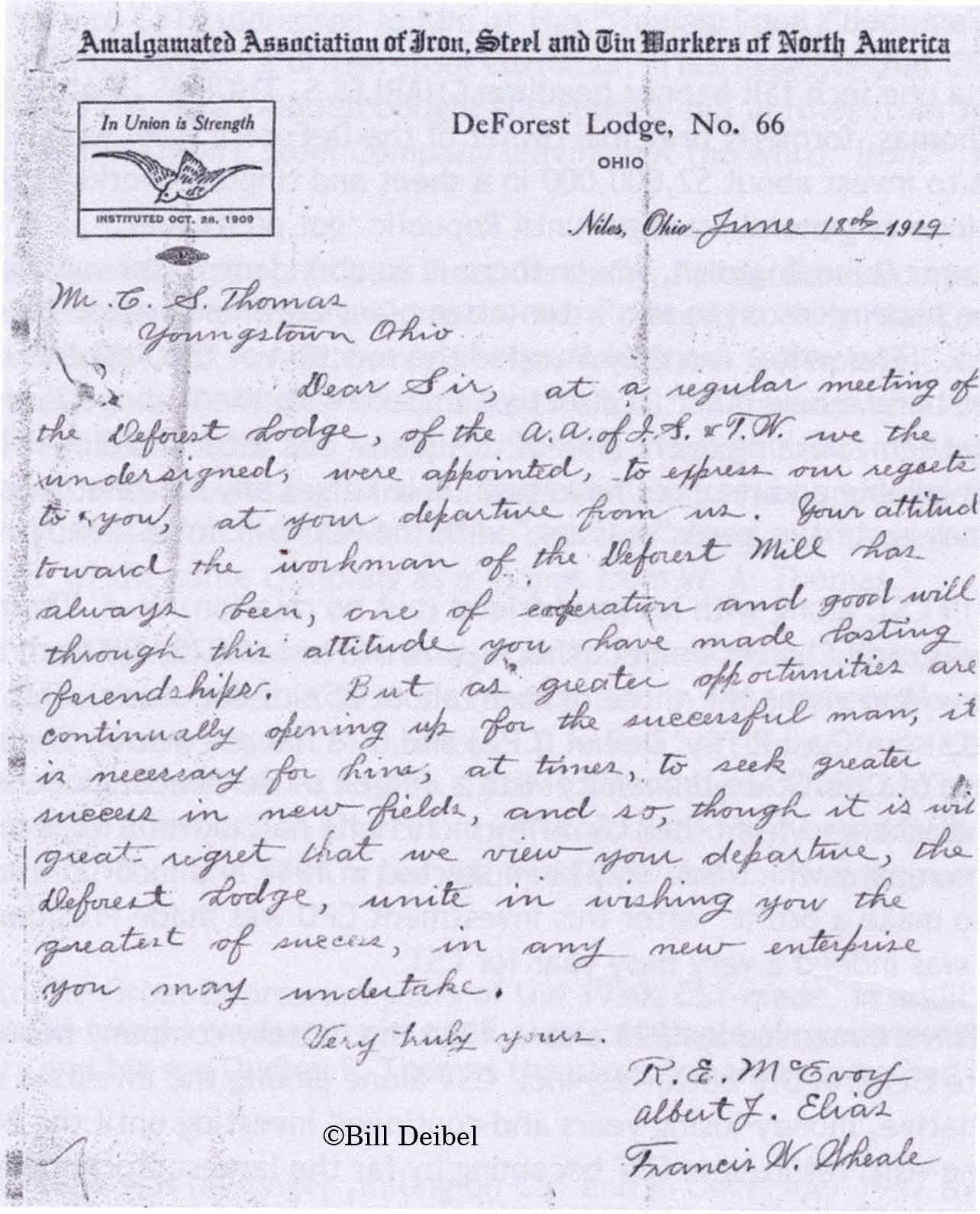
Letter from millworkers at Deforest steel plant to C.S. Thomas after sale of the plant. |
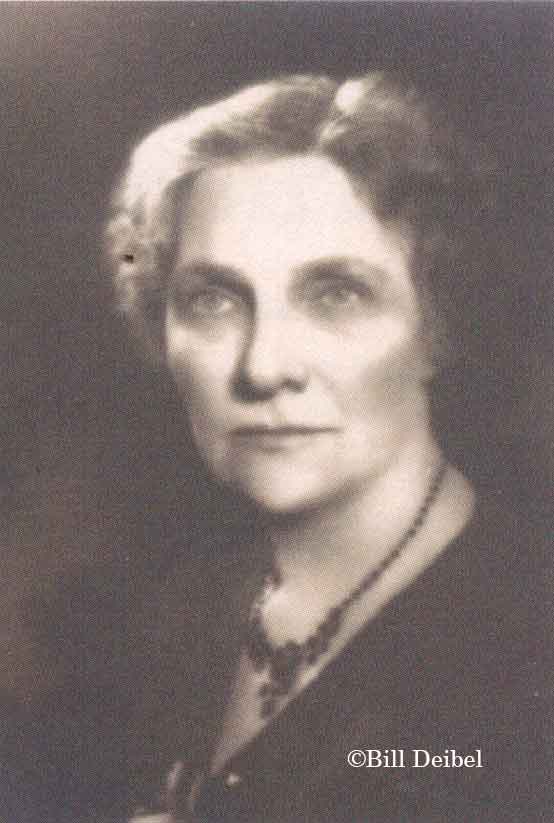
Mrs. Charles S. Thomas (Helen) |
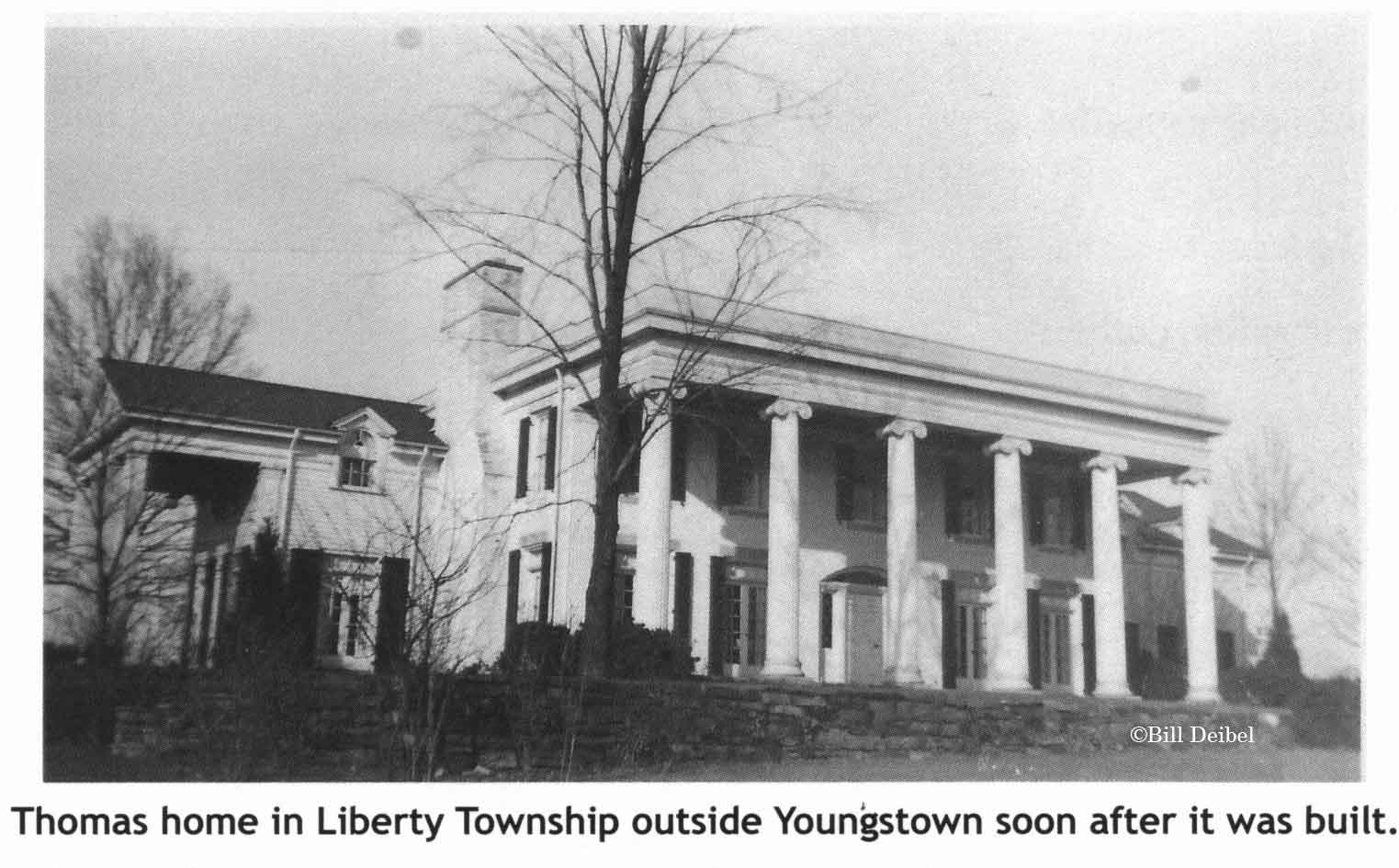
Thomas home in Liberty.
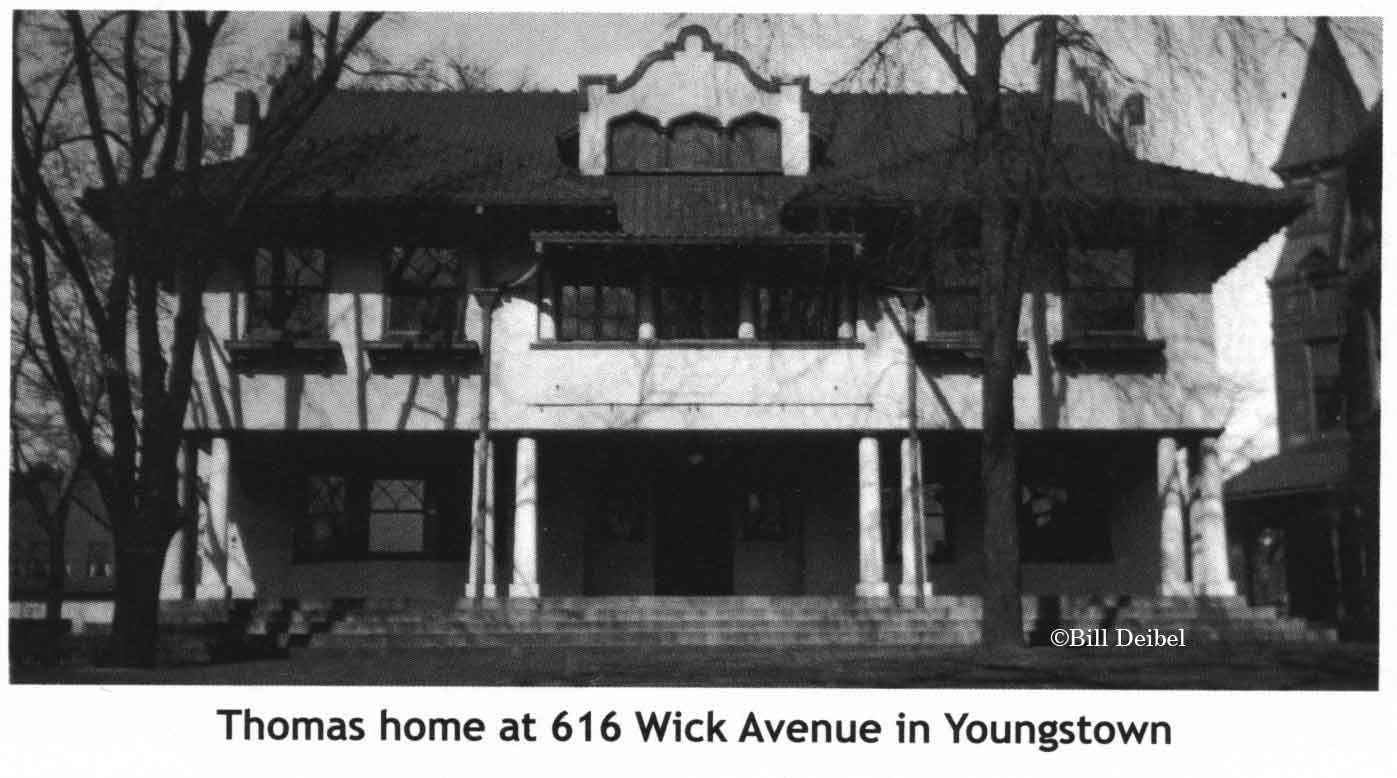
Thomas home in Youngstown. |
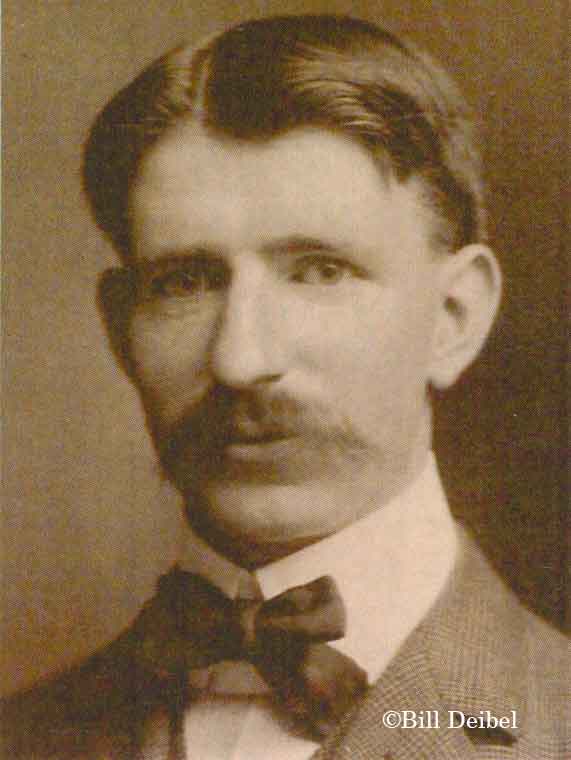
C.S. Thomas, 1895. |
Marion Thomas and Cy Deibel were married in 1923 and in 1924 the battery company became profitable. In 1927 its name was changed to General Dry Batteries, Inc. Charles S. Thomas alone among the investors maintained his confidence through the formative, money-losing years and continued investing until the battery company was on a solid profitable footing—this resulted in Charles Samuel Thomas becoming by far the largest stockholder. He remained a mentor to Cy Deibel and a director of the battery company until his health failed in the 1940s. (The company continued to prosper and at this writing it is known as Duracell and is going strong as a part of the Berkshire–Hathaway). In addition to the steel companies named above and the battery company, during the 20s and early 30s, Charles S. Thomas invested a major amount of the proceeds from the sale of Deforest in other Mahoning Valley steel companies including Brier Hill Steel Company (later sold to Youngstown Sheet & Tube), Niles Iron & Steel Company and The Thomas Sheet Steel Company all of which were located in Niles. He also invested in the Dollar Savings Bank of Niles and the Niles Ice Company. His investment in the Thomas Sheet Steel Company with W. A. Thomas as described below dwarfed all the rest of his industrial investments. During this time Charles S. Thomas served as a Director of the Dollar Savings Bank of Niles (which he helped organize), First National Bank of Youngstown, Dollar Savings & Trust Company of Youngstown and the Dollar Savings Bank of Warren. One or more of these banks were instrumental in financing the Warner Brothers of Hollywood fame as well as Harry M. Stevens who became concessionaire extraordinaire of professional sports stadiums across the country. |
|
| |
||
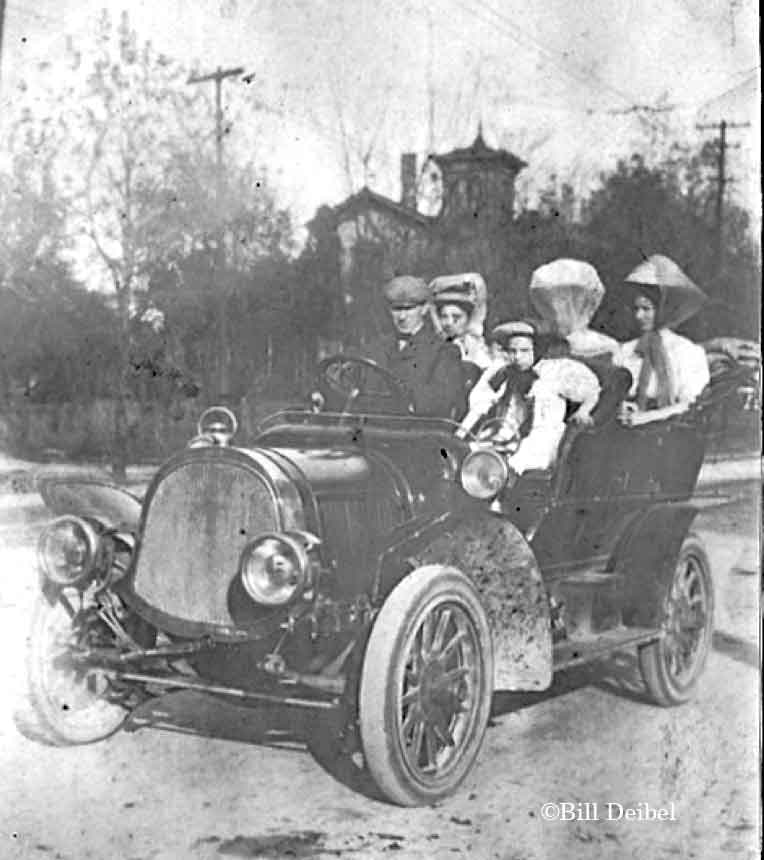 |
In 1924 Charles S. Thomas acting for himself and W. A. Thomas (as a secret partner) arranged the purchase of the “Thomas Mill” in Niles from Youngstown Sheet & Tube for $2 Million. Charles S. Thomas and W. A. Thomas were to invest $750,000 each. The company was incorporated as The Thomas Sheet Steel Company. A letter from W. A. Thomas to Charles S. Thomas written from Cairo, Egypt in February 1924 indicates that the Thomas Mill was at that time shut down, in a serious state of disuse and in need of substantial additional investment to get it fully operational. (This mill had been built in 1899 by W. A. Thomas and his brother Thomas Thomas along with James Patterson.) In this letter W. A. Thomas suggests that Myron Summers be made president, but a letter dated June 10, 1926 from a George Beach of New York to Charles S. Thomas, addressed to him at the "Thomas Steel Co.", thanks him for the courtesies he extended to Sir John C. Davies, a British steel customer. This suggests that Charles Samuel Thomas may have then been in charge of things. Also in 1924 Jacob (Jake) Waddell bought the Empire mill in Niles from Youngstown Sheet & Tube and incorporated it as the Empire Steel Company leaving out the word “iron”. This mill was also no longer in use at the time. Left: C. S. Thomas at the wheel of his first car, a 1906 Pope Hartford. Passengers are his daughter Marion in front and his niece Helen Summers, his sister-in-law Marian Summers and wife Helen l to r in back. |
|
|
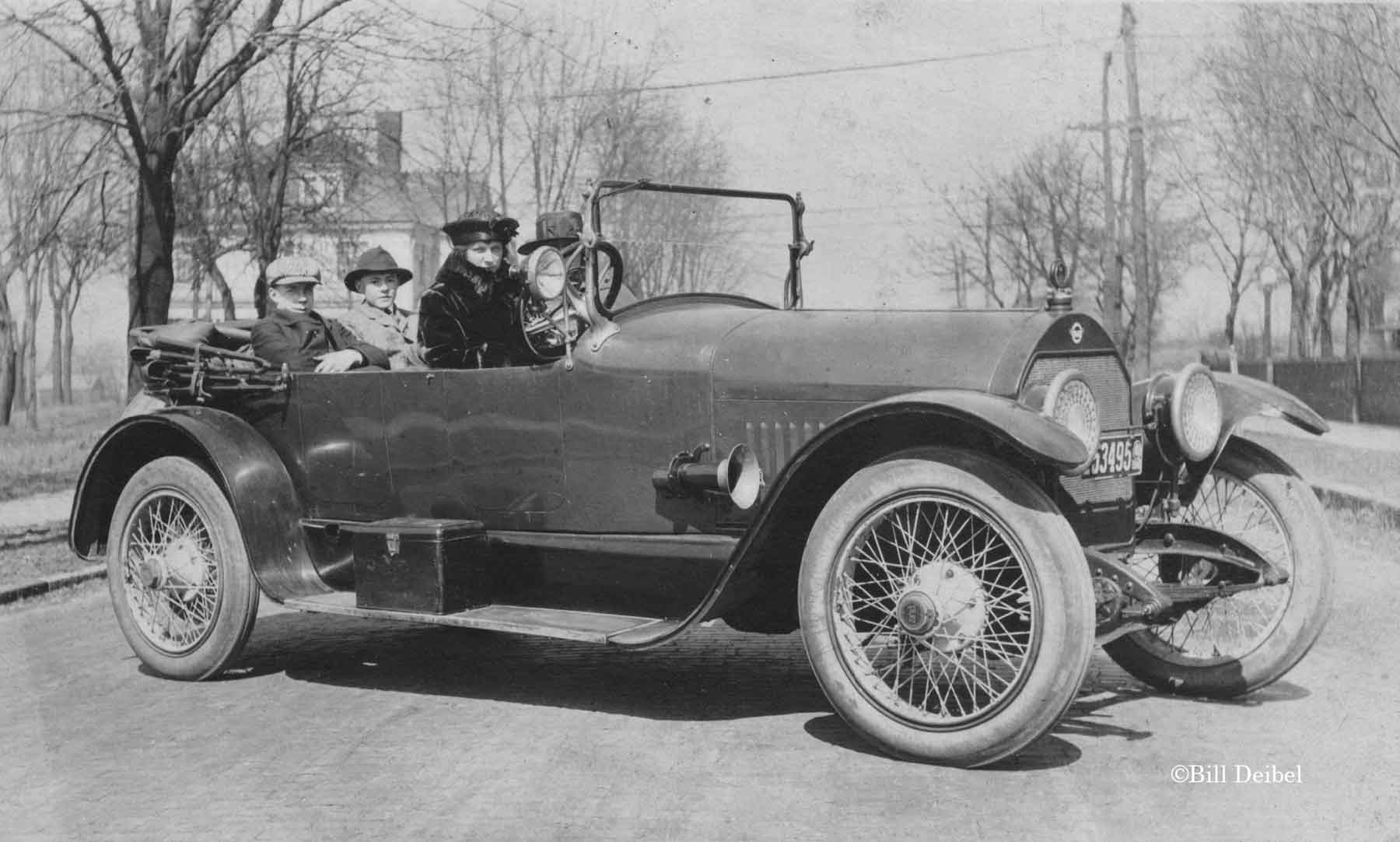
Four people in the Stutz Bulldog are Marion Thomas at the wheel, Myron Summers (car owner & Marion’s cousin) obscured in front seat, Dudley Thomas (Marion’s brother), left and Russell Cunnick, right in back seat. (This is not the same Stutz as in the other photo.) Photo date unknown, but car appears to be about a 1916 or 17 model. Dudley was born in 1903 so you can guess his age. Since the family moved to Youngstown in 1917 this photo could have been taken in Youngstown. |
In 1928 the Thomas Sheet Steel Company, Empire Steel Company, Falcon Steel Company, Ashtabula Iron & Steel Company and Mansfield Sheet & Tinplate Company were merged to form the Empire Steel Corporation with headquarters in Mansfield, Ohio. W. H. Davey of Mansfield Sheet & Tinplate Company became President and A. J. Davey Secretary. J. D. Waddell, Lloyd Booth and C. S. Thomas were among the directors. In addition to his Thomas Sheet Steel stock and Mansfield Sheet & Tinplate bonds, Charles Samuel Thomas had acquired (date unknown) $110,700 par value bonds of Ashtabula Iron & Steel Company. He purchased these at a discounted price of $100,030 and the undated record shows that he received along with these bonds an additional $10,000 of 8% "Gold Bonds" of the same company as a “bonus from W. A. Thomas.” As the depression set in, the Thomas Mill and the Empire Mill, both recently refurbished but with aging equipment, were early casualties —idled in 1930 and dismantled in 1934 by the Empire Steel Corporation, which by 1937 was itself out of or going out of business. (I have a certificate for 10,253 shares of common stock of the Empire Steel Corporation dated Aug 21, 1928 in the name of Chas. S. Thomas and certificates for 1,143-½ shares of common and 1,862-½ shares of preferred dated between March 19, 1928 and April 1, 1929 in the name of Marion S. Thomas–all at a par value of $100/share. That last certificate makes for a symbolic April Fool’s Day. |
|
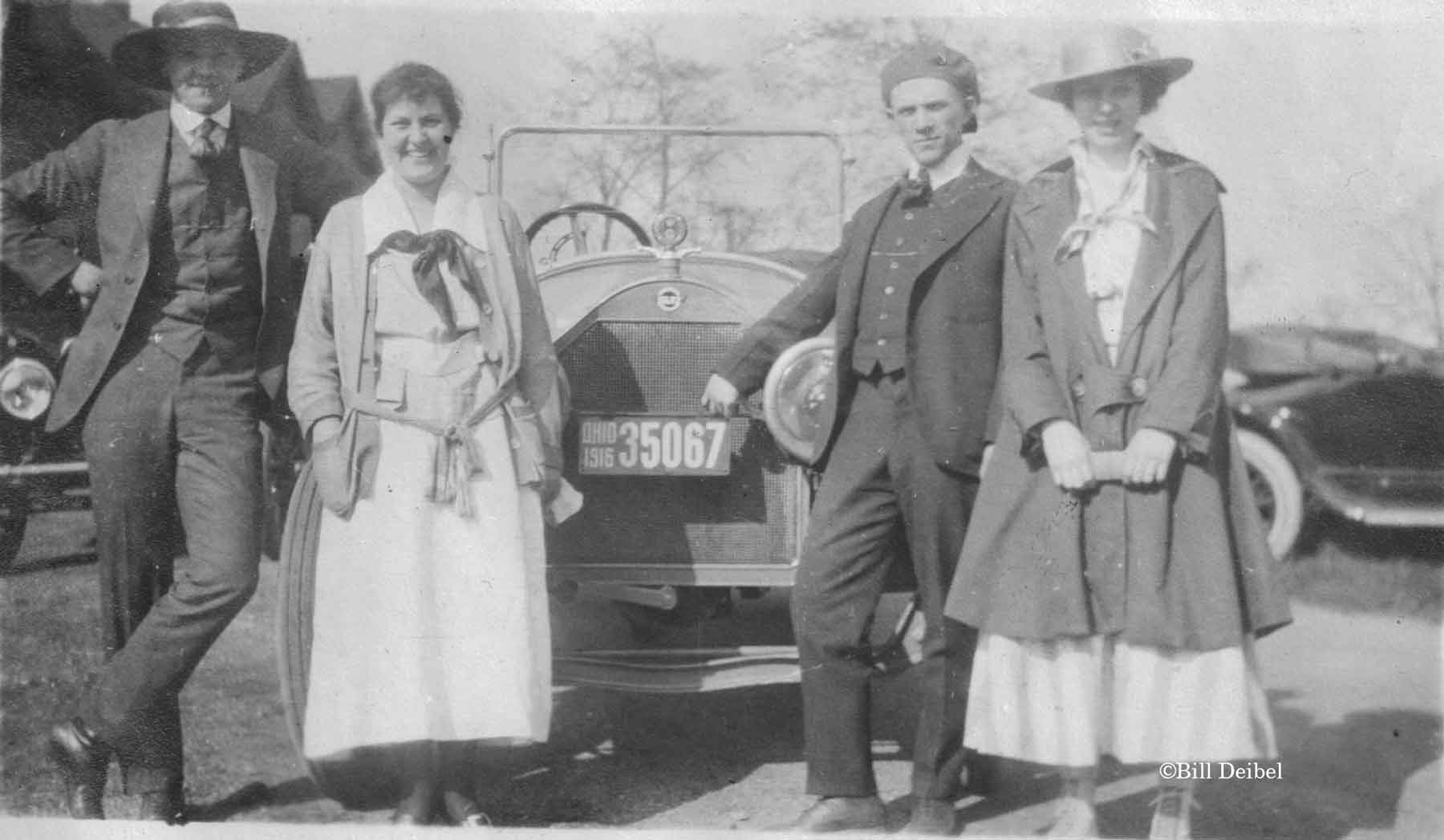
Four people standing with the Stutz bearing 1916 plates are left to right, Peter Deibel from Youngstown, Isabelle Wallace, John Clingan and Marion Thomas, all three from Niles. |
In the mid 1920s and into the Great Depression years of the 1930s Charles S. Thomas made, in addition to those described above, a number of other ill-fated investments in small steel companies in an attempt to give his nephew/cousin Myron C. Summers and his son Dudley S. Thomas the same opportunity he had helped to give his son-in-law, Cy Deibel. By the mid 1930s good fortune was no longer smiling on Charles S. Thomas and in December 1937 the Republic Steel Corporation brought collection proceedings against the Pittsburgh Cold Rolled Steel Company for an outstanding obligation of a $26,389.75 which was personally guaranteed by Charles S. Thomas. (About $400,000 in 2013 dollars.) Charles S. Thomas had bought all or most of this company and appointed his nephew/cousin Myron Summers President and his son, Dudley S. Thomas Treasurer. Now Charles S. Thomas no longer had access to enough money to cover this debt which 10 years earlier would have been a relatively paltry sum to him. Cy Deibel asked Republic for a 90-day extension promising to raise the money himself to settle this obligation. Republic Steel refused this offer and the Union National Bank in Youngstown called an $8,000 note from Charles S. Thomas and seized the collateral. This resulted in three other banks following suit for secured notes totally over $72,000. Together this resulted in Charles S. Thomas filing for Bankruptcy in January 1938. |
|
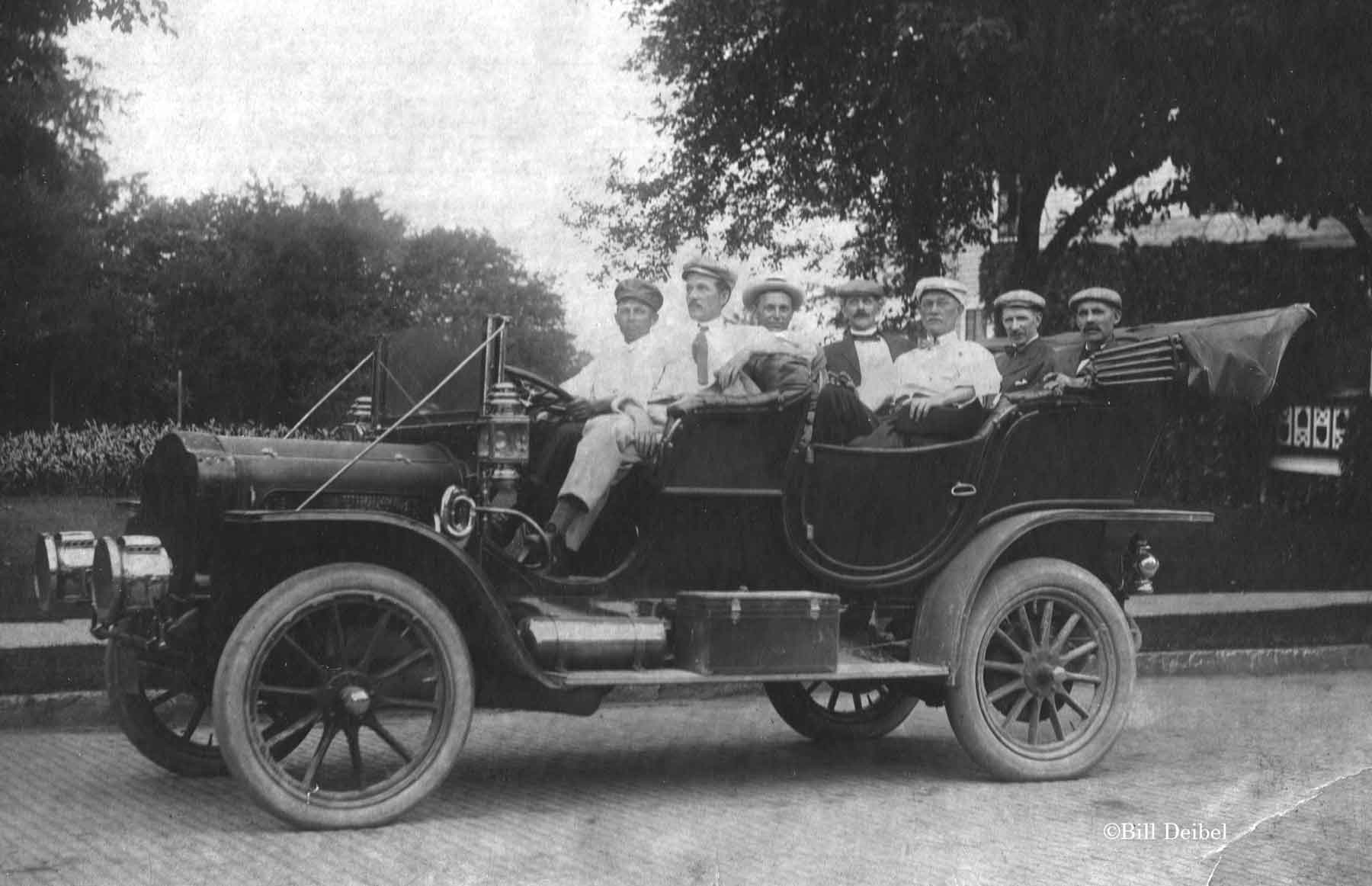
“WA” Thomas in his White Steamer: The men are as follows, left to right, chauffeur, “WA" Thomas, Jake Waddell, Dr. Claypool, W. J. Bentley, Charles S. Thomas and William H. Pritchard. Photo taken c. 1908. |
C. S. Thomas, early to mid 1930s. The largest obligation was to the Dollar Savings & Trust Co. of Youngstown (of which Charles S. Thomas had once been a Director) for $56,500. The collateral for this loan included 1,400 shares of General Dry Battery Co. stock while another 1,700 shares were scattered among the three other banks. Only with Herculean effort was Cy Deibel (who owned relatively little battery company stock himself) able to raise enough cash to settle the loan with the Dollar Savings & Trust Co. on a discounted basis. This was accomplished only with crucial help from the Cleveland Trust Company in the form of a loan to Cy Deibel and its agreement to buy the three other loans— probably guaranteed by Cy Deibel. The bankruptcy was not finally settled until about December 1940. After claims from family members for loans they had made to Charles Samuel Thomas. Charles S. Deibel then helped his mother-in-law, Helen S. Thomas, see to it that all unsecured creditors, mostly small local businesses and service providers, were paid in full. On the surface of it there seems little sense in Republic’s rebuffing of Cy Deibel’s offer. (It is with great poignancy that the writer notes the sale of Charles S. Thomas’s 1934 Chrysler Imperial Airflow sedan on March 30, 1938 for $350.00 in the final federal bankruptcy report). |
|
Caroline Weaver Deibel in her early electric car with her nephew Cy Deibel around 1900. |
In 1941, following three highly profitable years for the battery company, Cy Deibel loaned Charles S. Thomas the funds to build a new home in the country outside Youngstown. All of Charles S. Thomas' fortune from the steel business was gone—he admitted to losing $800,000 in the Thomas Sheet Steel Company (the Thomas Mill) alone. Not withstanding the inexperience of Myron Summers and Dudley Thomas, Charles S. Thomas’s lack of success after the sale of Deforest was, in this writer’s mind, primarily related to the competition changing from small turn-of-the-century mills to giant steel corporations with newer and much more sophisticated plants and management as well as greater purchasing and sales power and financial resources – and, of course, the Great Depression. Nevertheless, had Charles S. Thomas been able to hold out two more years the defense build–up prior to World War II probably would have solved, at least for a decade, whatever problems Myron and Dudley were having. Despite his Welsh/English ancestry Charles S. Thomas never considered himself other than a proud Scotsman. He and his wife Helen were total abstainers from alcohol. In fact, Charles S. Thomas wrote to Helen from Pittsburgh on January 22, 1895 while attending Duff’s Mercantile College “I suppose you will be glad to hear that I have signed the pledge”. Charles S. Thomas became a 32nd degree Mason of the Scottish Rite, a Knights Templar of the York Rite and a member of Al Koran Temple of the Mystic Shrine. Although not a religious man, Charles S.Thomas had been a member of both the Methodist and Presbyterian churches. Charles S. Thomas was a life-long Republican and ardent protectionist. He was an avid golfer, a member of the Youngstown Country Club and a founding member of the Trumbull Country Club in Warren. He was also a member of the Youngstown Club and the Union Club in Cleveland. Charles S.Thomas suffered from bleeding ulcers most of his life, but died at home of prostate cancer at age 76 on February 18, 1945 less than a month after Cy Deibel passed away. |
|
| |
||
|
|
||