Ward-Thomas Museum


The Milltown: Merger and Diversification 1900 - 1930
Ward — Thomas
Museum
Home of the Niles Historical Society
503 Brown Street Niles, Ohio 44446
Click here to become a Niles Historical Society Member or to renew your membership
Click on any photograph to view a larger image, click on image again to zoom into photograph.
|
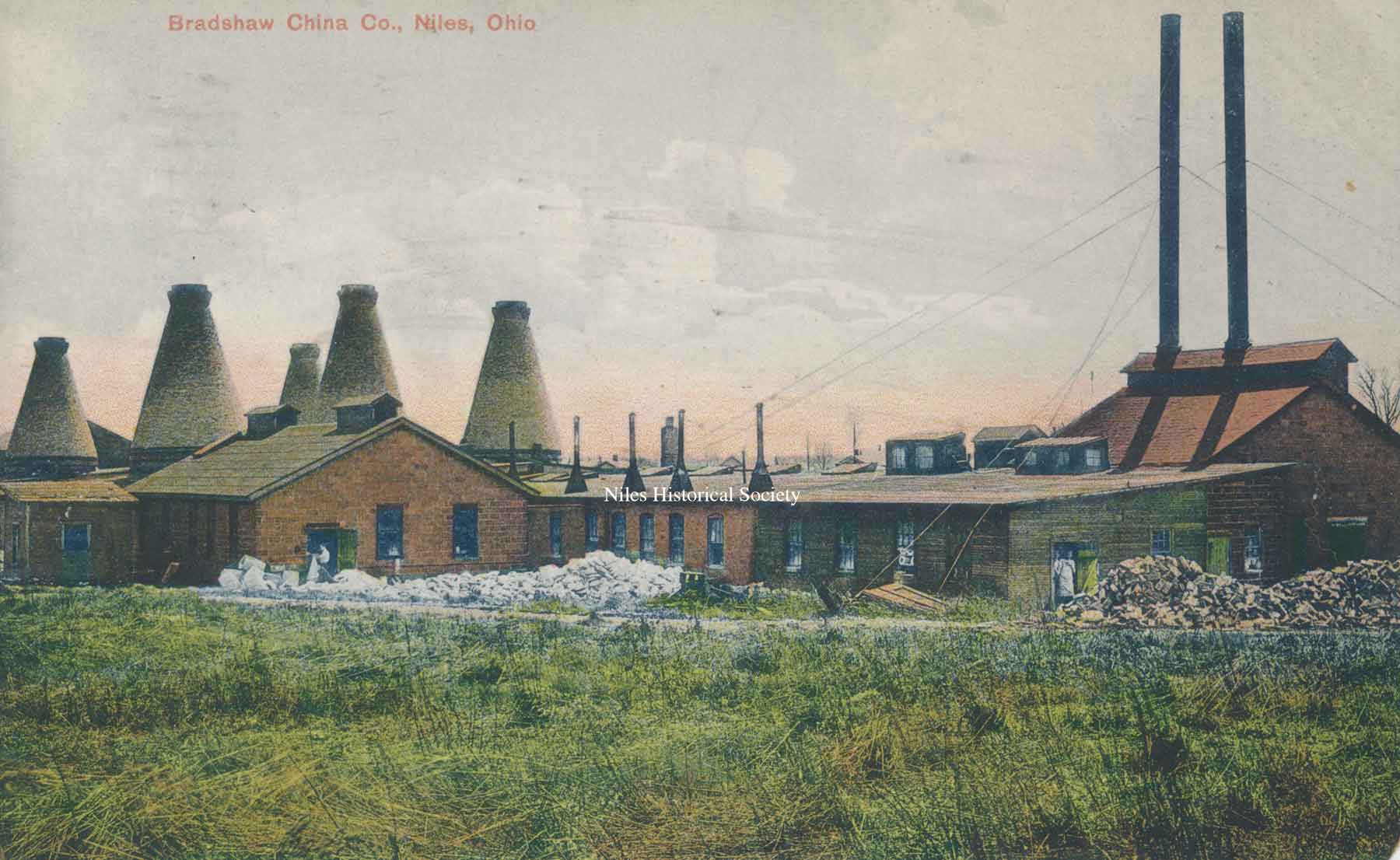
The Bradshaw Pottery Plant was built between Hunter Street and the railroad right-of-way in Roundstown. In digging the foundation a big bed of clay, the type used in making red building bricks, was discovered. Construction of the building began in April 1901, and by October the plant was shipping pottery. PO1.509
|
The Milltown: Merger and Diversification 1900 - 1930 During the first three decades of the 20th Century, 1900-1929, fundamental changes occurred in the industrial develpment of Niles.By 1900, the iron and steel industry had reached maturity. The consolidation of small, isolated plants signalled the impending of the locally-owned mill. By 1905, every one of the local iron and steel mills were gone: Falcon Iron & Nail, Russia Mill, the original Ward Mill, later the Coleman-Shields mill. Undaunted by the virtual collapse of the city's industrial foundations, Niles industrialists, led by the newly-organized Board of Trade, established a new diversified economy which doubled the population over 30 years. Two new rolling mills were opened in 1902, the Niles Car & MFG. began building electric street cars in 1901 and later trucks then planes during WWI. The Harris Automatic Press Company, with a Niles family as its founders, operated until 1914. The Fostoria Glass Works began operations in 1910 and was soon acquired by General Electric. The Bradshaw China Company started operations in 1901, later becoming the Tritt China Company in 1910 and in 1923, the Atlas China Company. The prospering Niles Fire Brick Company built a second plant on Langley Street. Other new inustries were: Standard Boiler & Plate, Stanley Works, Niles Iron & Steel Roofing, Ohio Galvanizing, Sykes Metal Lath, Niles Forge & Manufacturing, and Wilder Manufacturing. Part 1: Milltown,
the Early Years 1843-1873. |
|
| |
||
|
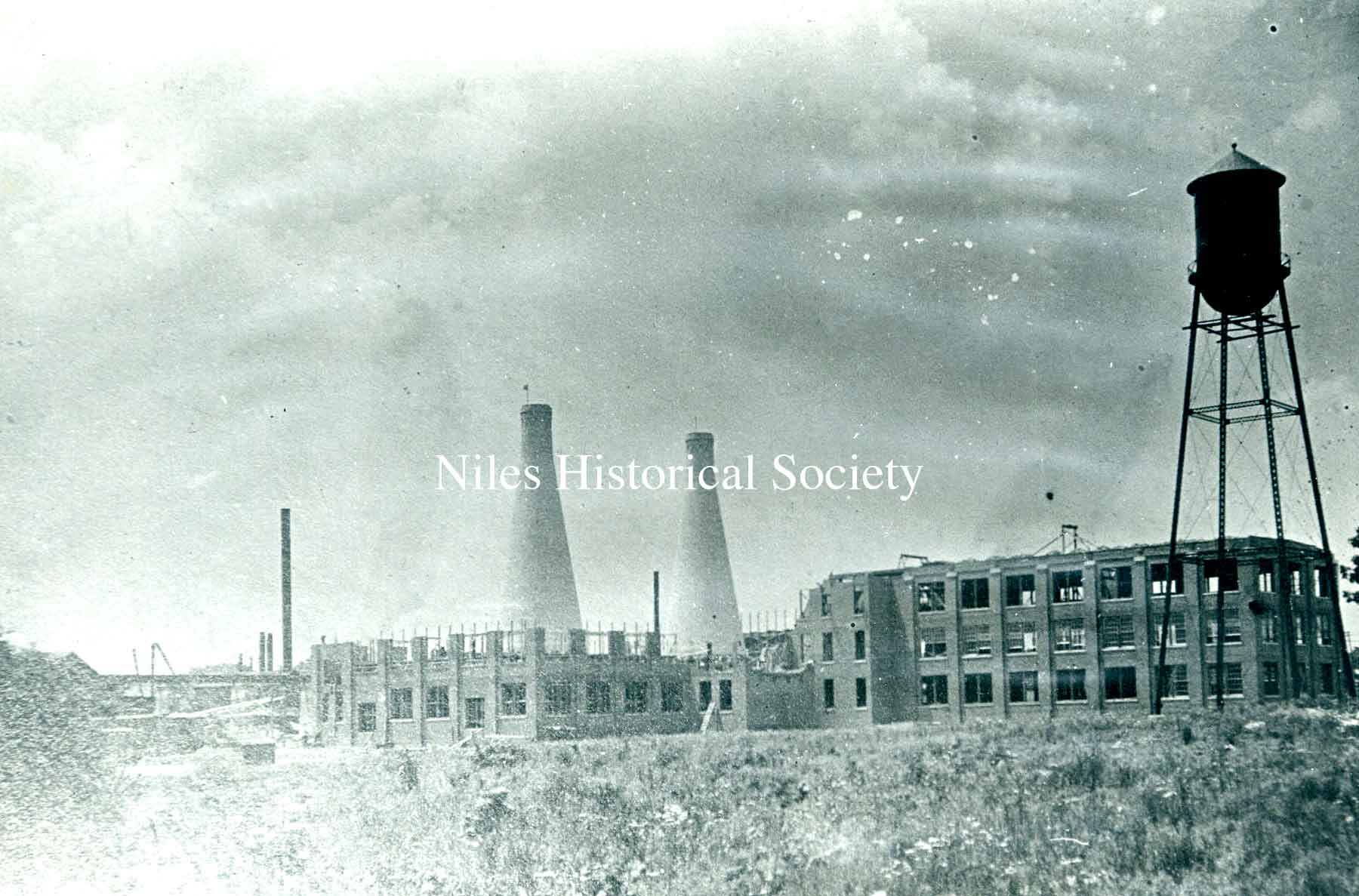
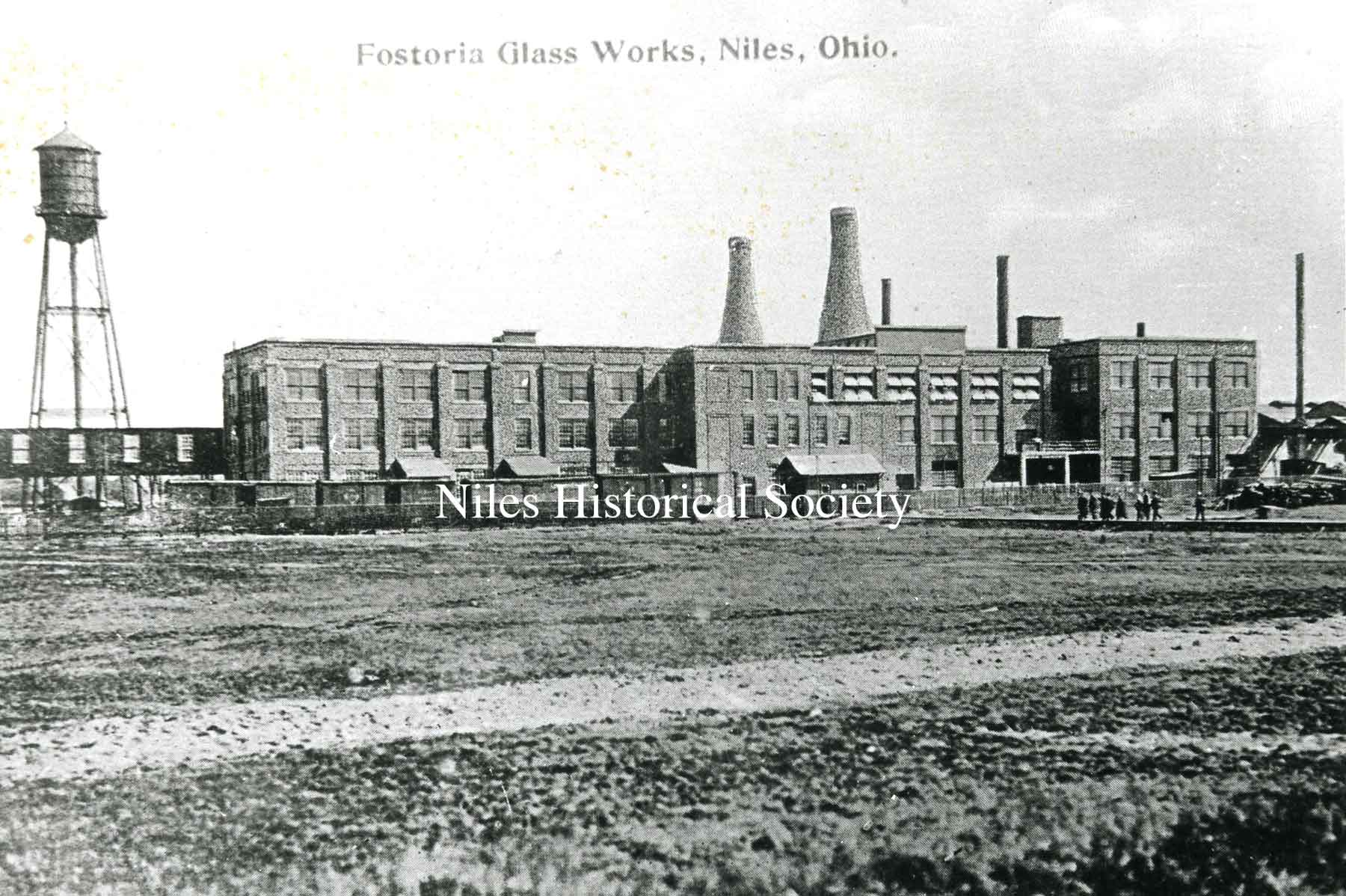
View of the construction of the Fostoria Glass Works which took place in 1910 on the corner of Main and Federal Streets in Niles. PO1.524
Fostoria Glass Works was constructed in 1910 by Fostoria Glass Company, many of the first employees moved here from Fostoria, Ohio. PO1.523 |
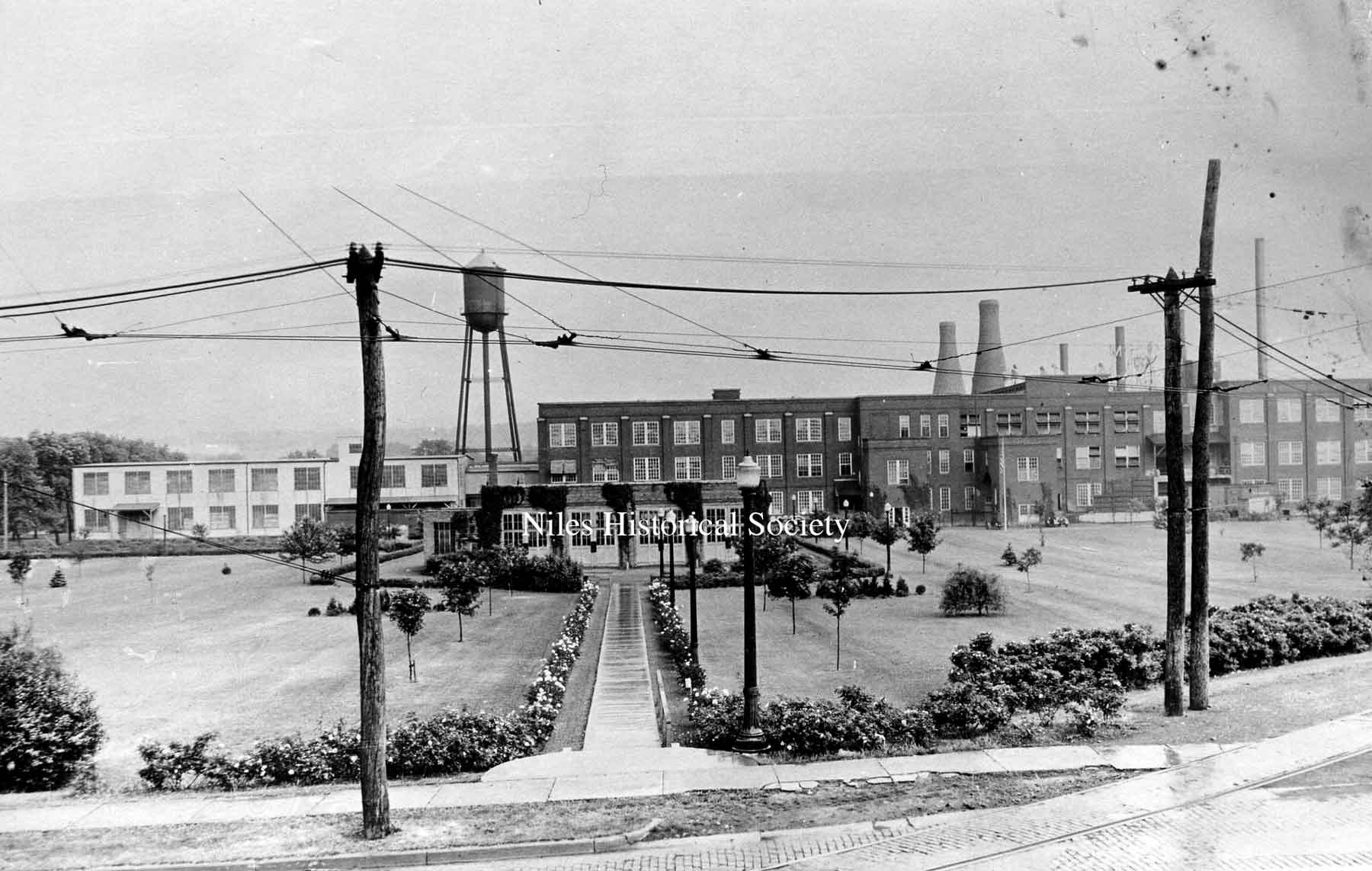
The General Electric Plant and grounds. It was built about 1909-1910 and merged with National Lamp and GE in 1911. PO1.526A
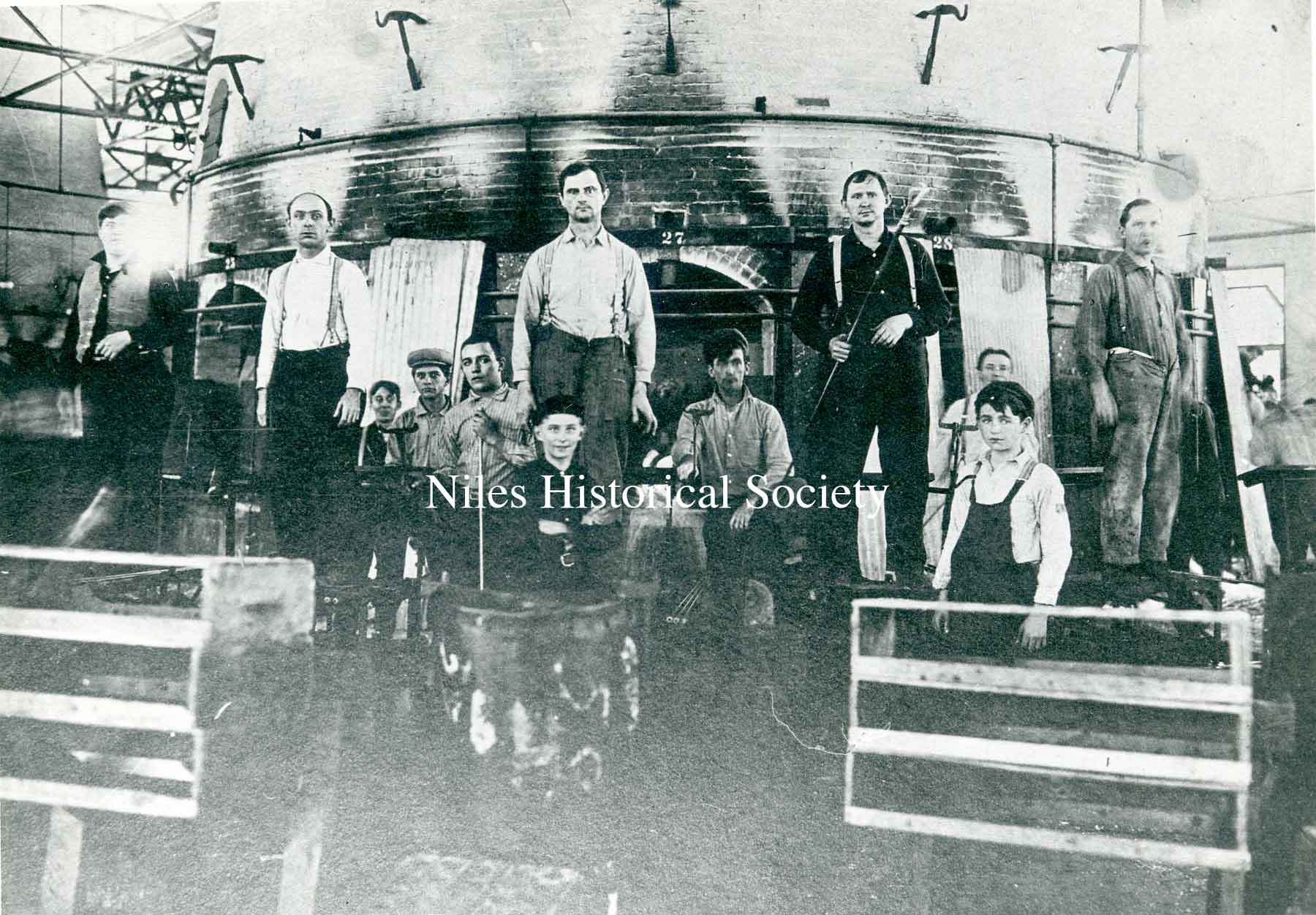
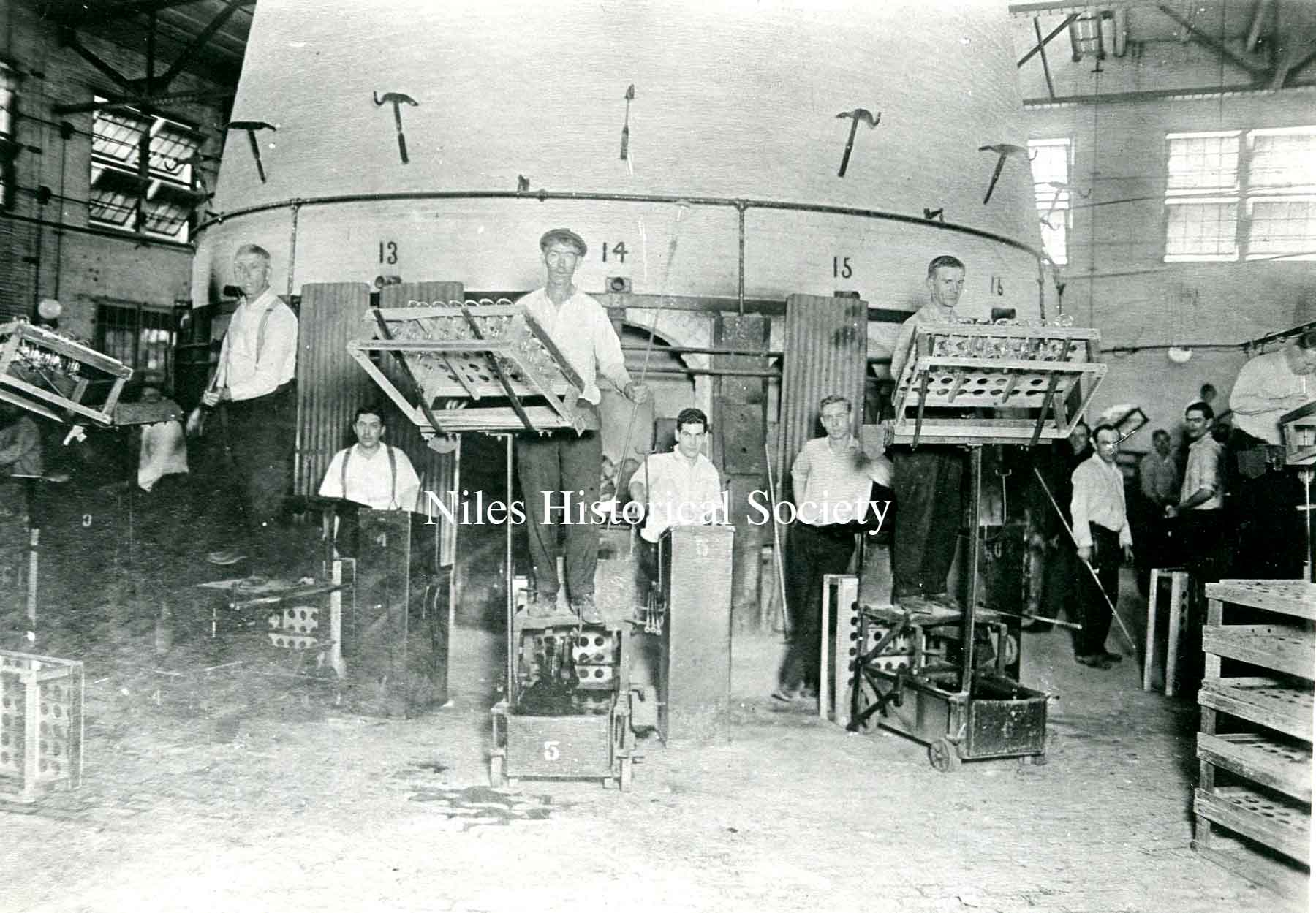
Photo of the “glass blowers” prior to mech-anization of making of electric light bulbs. PO1.529 |
Hand blown glass bulbs were the initial products. Large circular kilns contained molten glass in pots which was extracted through 16 curtain doors on the end of five foot tubes by gatherers who handed the tube to the blower. Blowers on pedestal moulds left to right: E. McGowan, John Curtis. Gatherer at station 14- Mr. Sebinaller. General Electric acquired the plant about 1911 and mechanized the process. Before mech-anization in the early twenties, 205 blowers blew about 225,000 bulbs per day. A blower and gatherer could blow 1100 bulbs in an 8 hour day. After mechanization, 2 men and a machine could make 3,000 to 5,000 bulbs per hour. PO1.530 |
| |
||
|
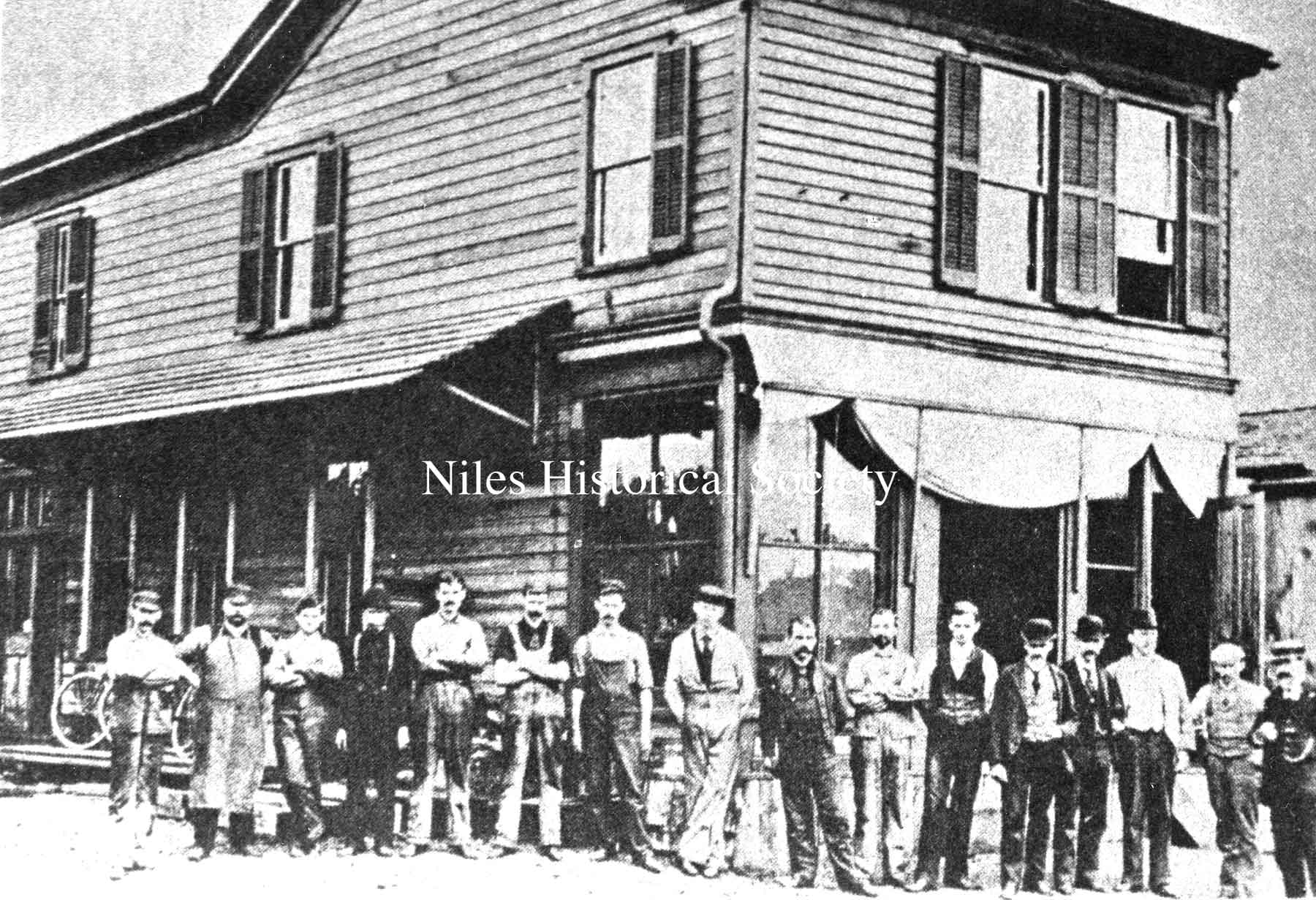
The employees of the Harris Automatic Press Company around the turn of the previous century. Charles and Alfred Harris are the fourth and fifth gentlemen from the right. The half-house in the picture was the boyhood home of William McKinley; later it served as the Harris Company’s first plant. The house stood on the site of the McKinley Research Center and the Old Main Ale & Chowder House. PO1. 550 |
The Harris Automatic Press plant was constructed in 1904 with a Board of Trade grant of $1500.00 and a free site. The plant operated until about 1914, when after a prolonged strike, operations were moved to Cleveland. Prior to being dismantled, it was used as a soup kitchen during the Great Depression. PO1.546 |
This is an architect’s rendering of suggested expansion of the Harris Automatic Press Co., Niles Plant, which never occurred. The plant was sold in 1914 after a costly and prolonged strike which forced management to move operations to Cleveland. PO1.551 |
| |
||
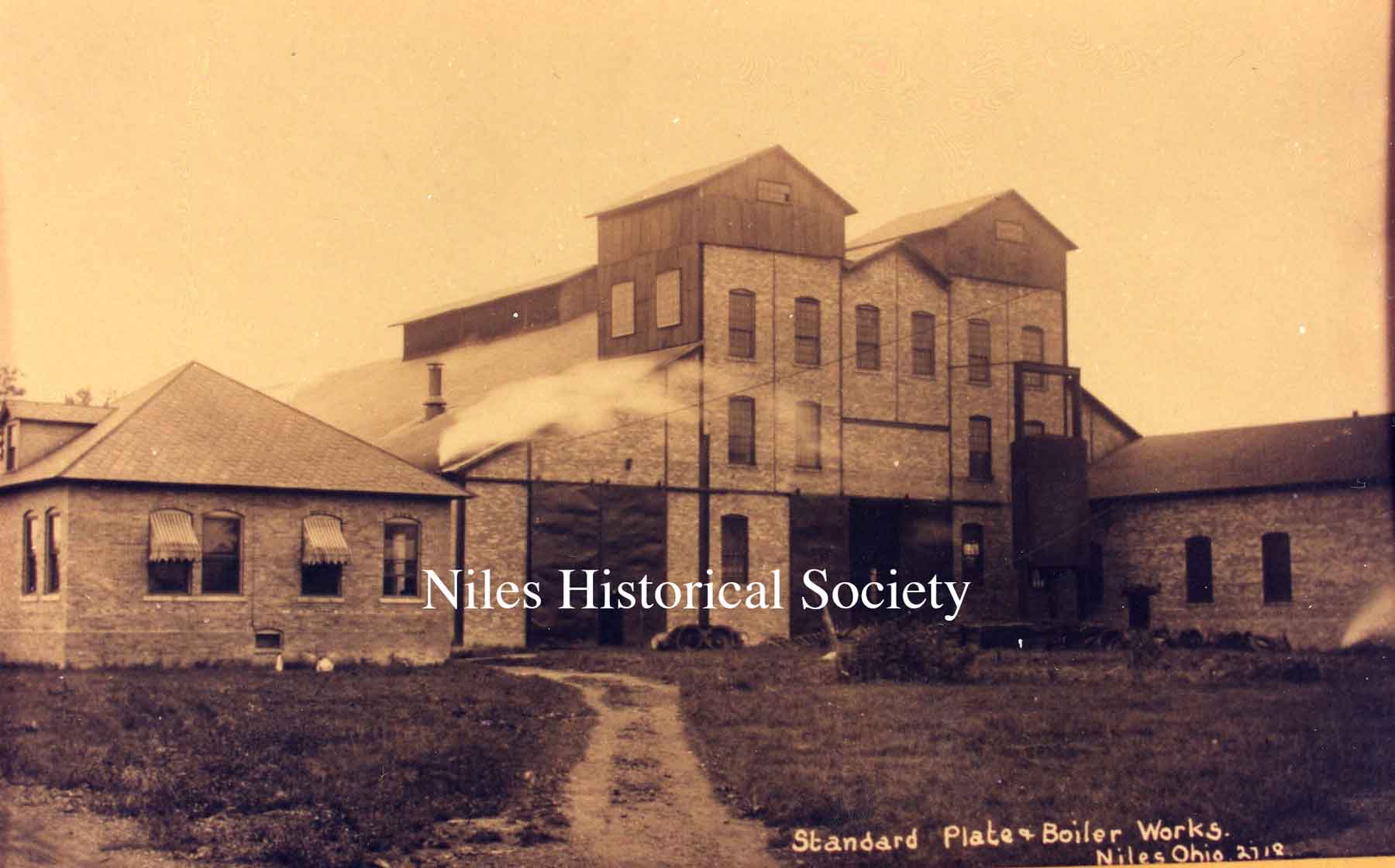
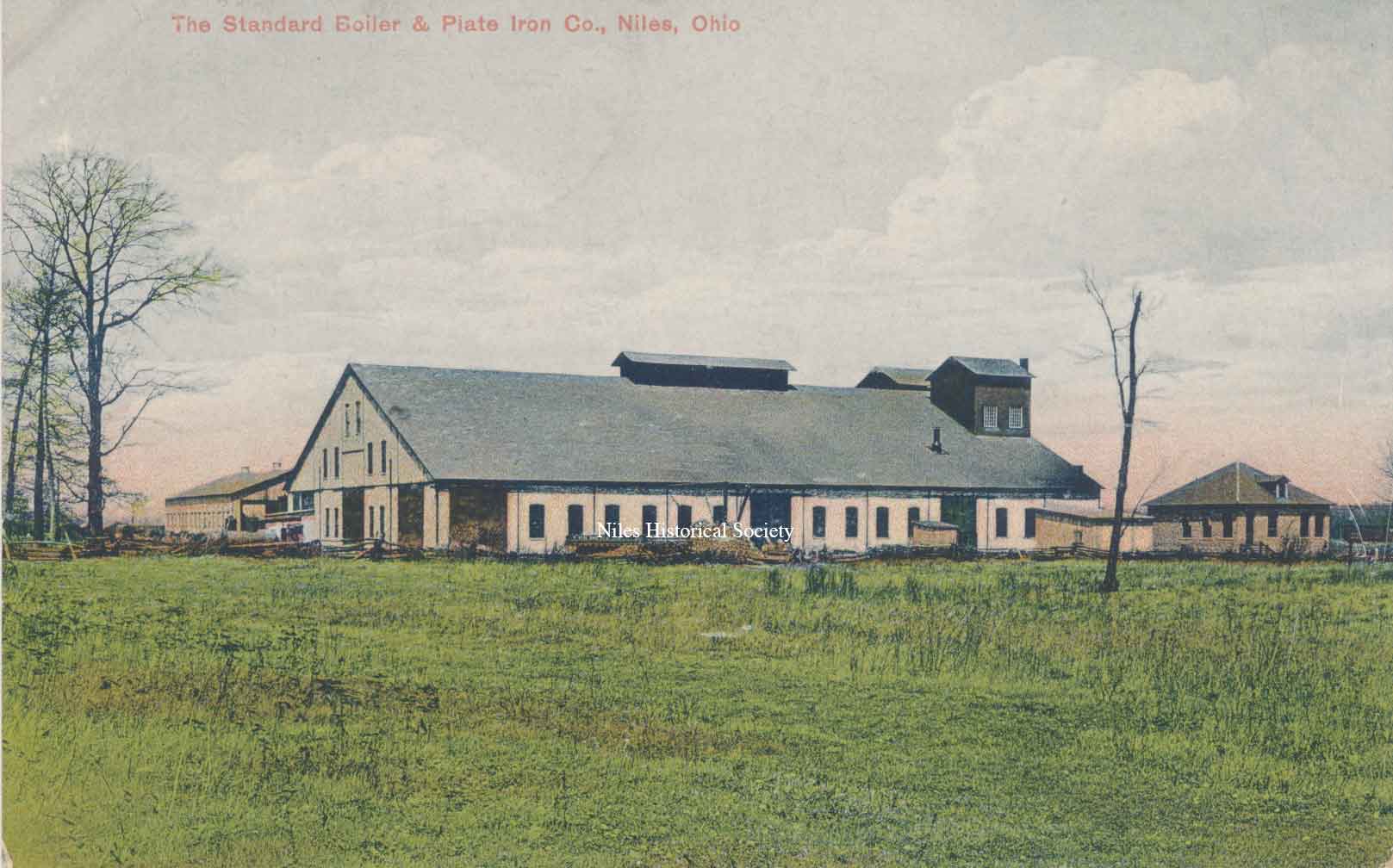
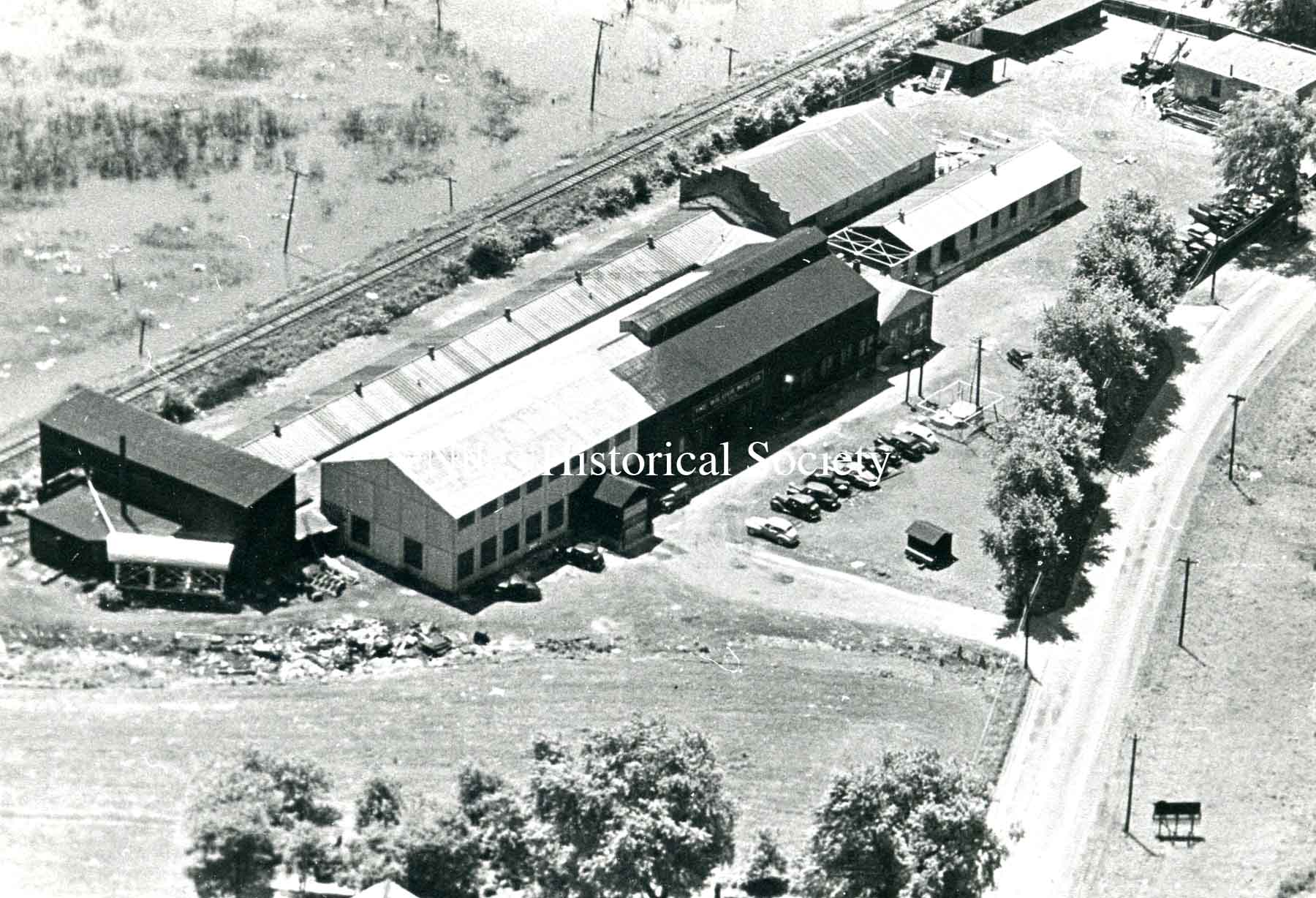
Standard Boiler & Plate Iron Co. started in 1906 by D. J. Finney, E. A. Gilbert and others. PO1.624
|
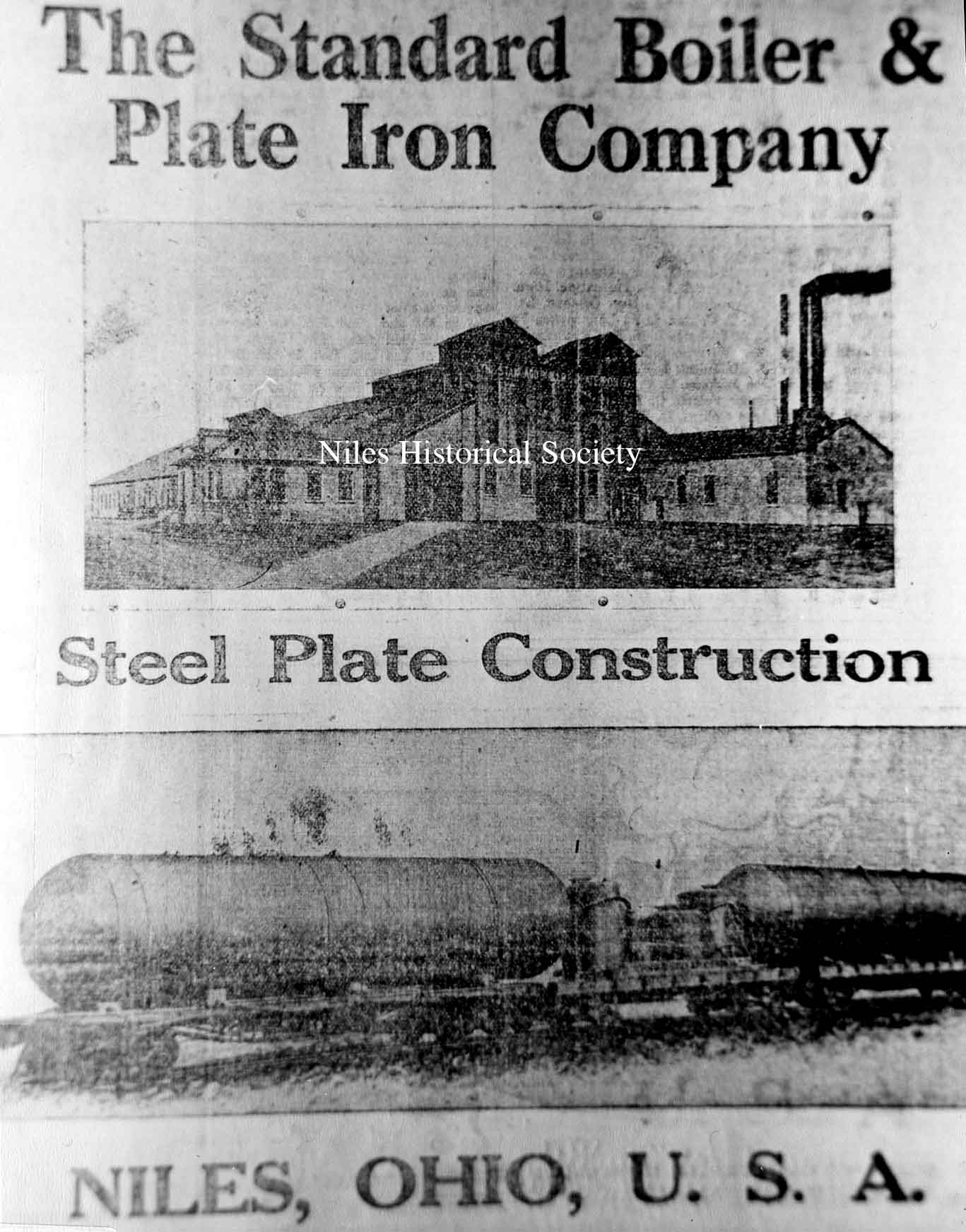
Above: Postcard view of Standard Boiler & Plate Iron Company. PO1.625 Right: An advertisement from the Niles Daily News dated October 5, 1917 for the Standard Boiler & Plate Iron Company located in Niles, Ohio. PO1.623 |
|
Wilder Metal was constructed in 1922 by John Wilder on Route 46 between Niles and Evansville and was one of Niles’ fabricating plants. Production discontinued after WWII. PO1.636 |
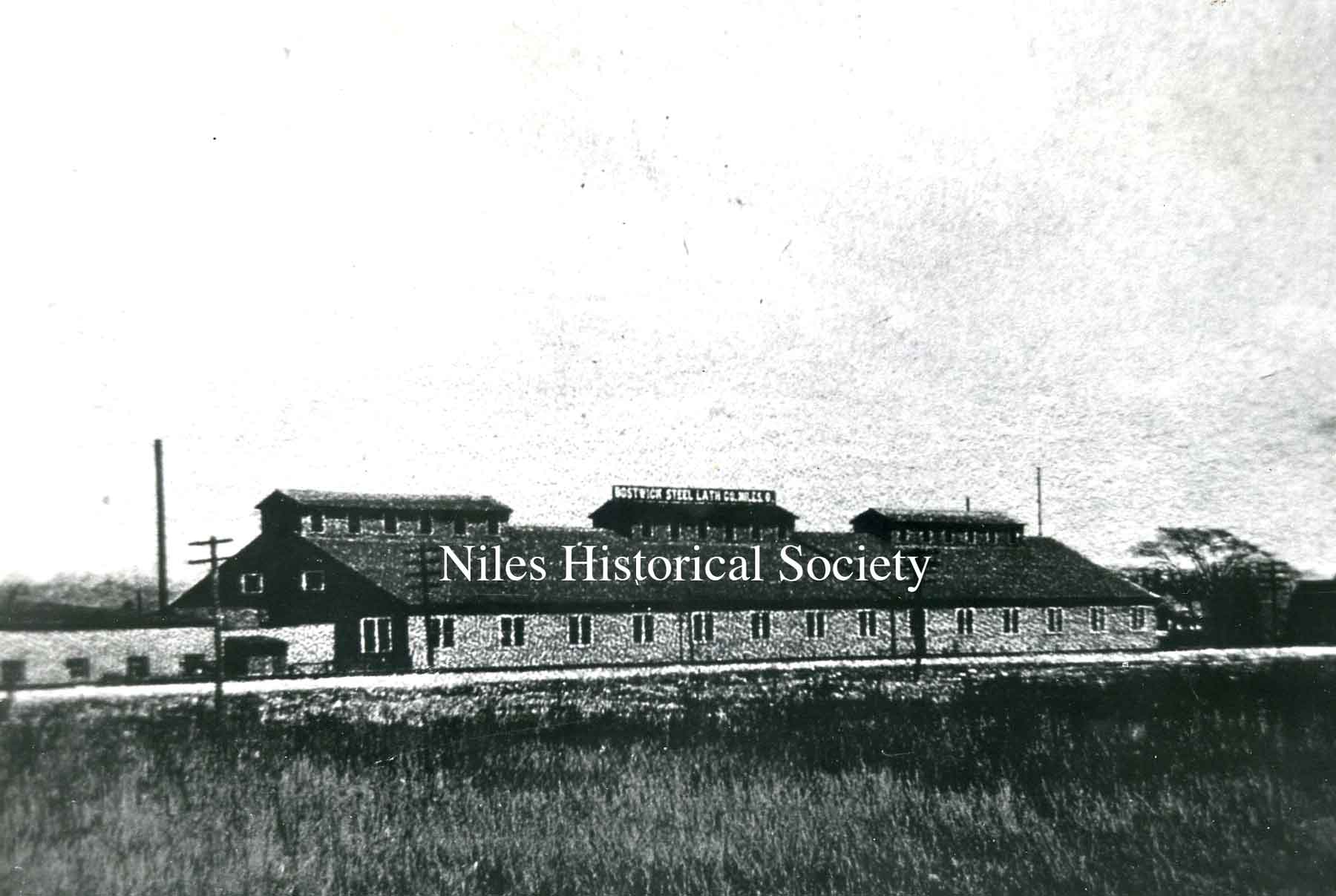
Bostwick Steel Lath Company. In 1891 Tod Ford, W. G. Hurlburt and W. W. Bostwick built what, in 1976 was the oldest industry active in Niles. PO1.505 |
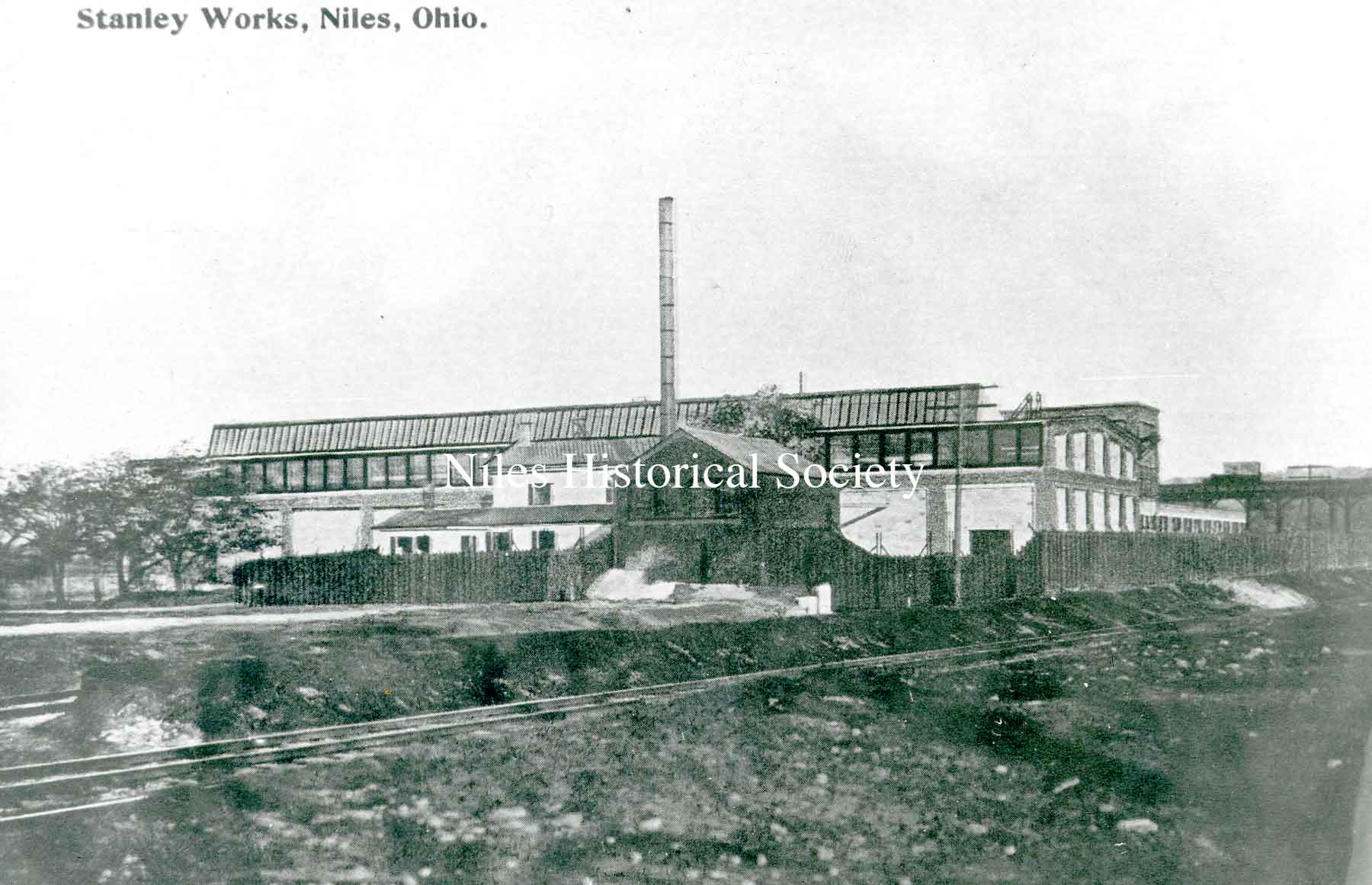
The Stanley Works Company was constructed in 1910 by the company out of New Britain, Conn. It manufactured nuts, bolts, washers and small fittings. Operations were limited after WWII and the plant was sold in the 1950’s. In 1976, it was rented to Aluminum Billets, Inc. PO1.626 |
| |
||
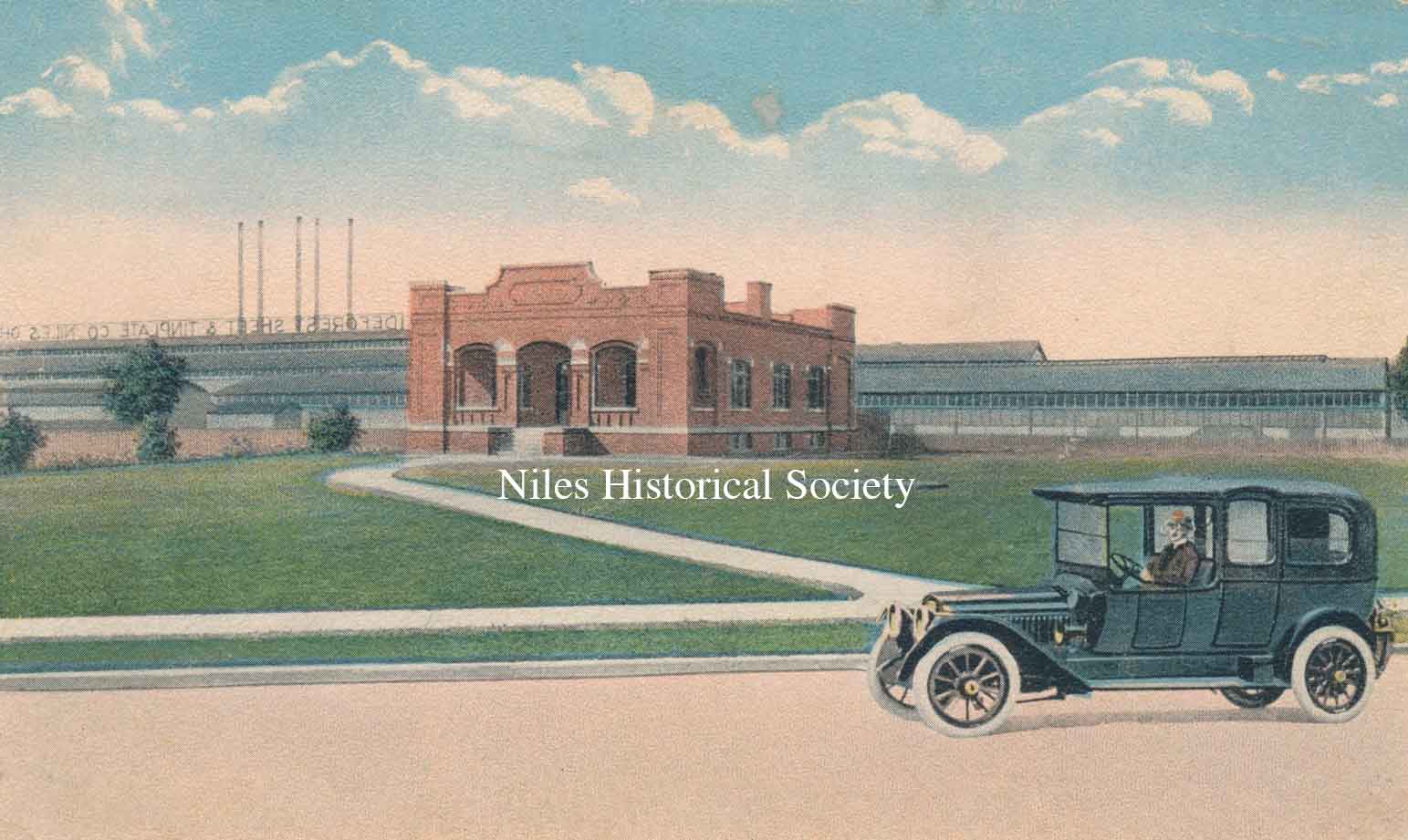
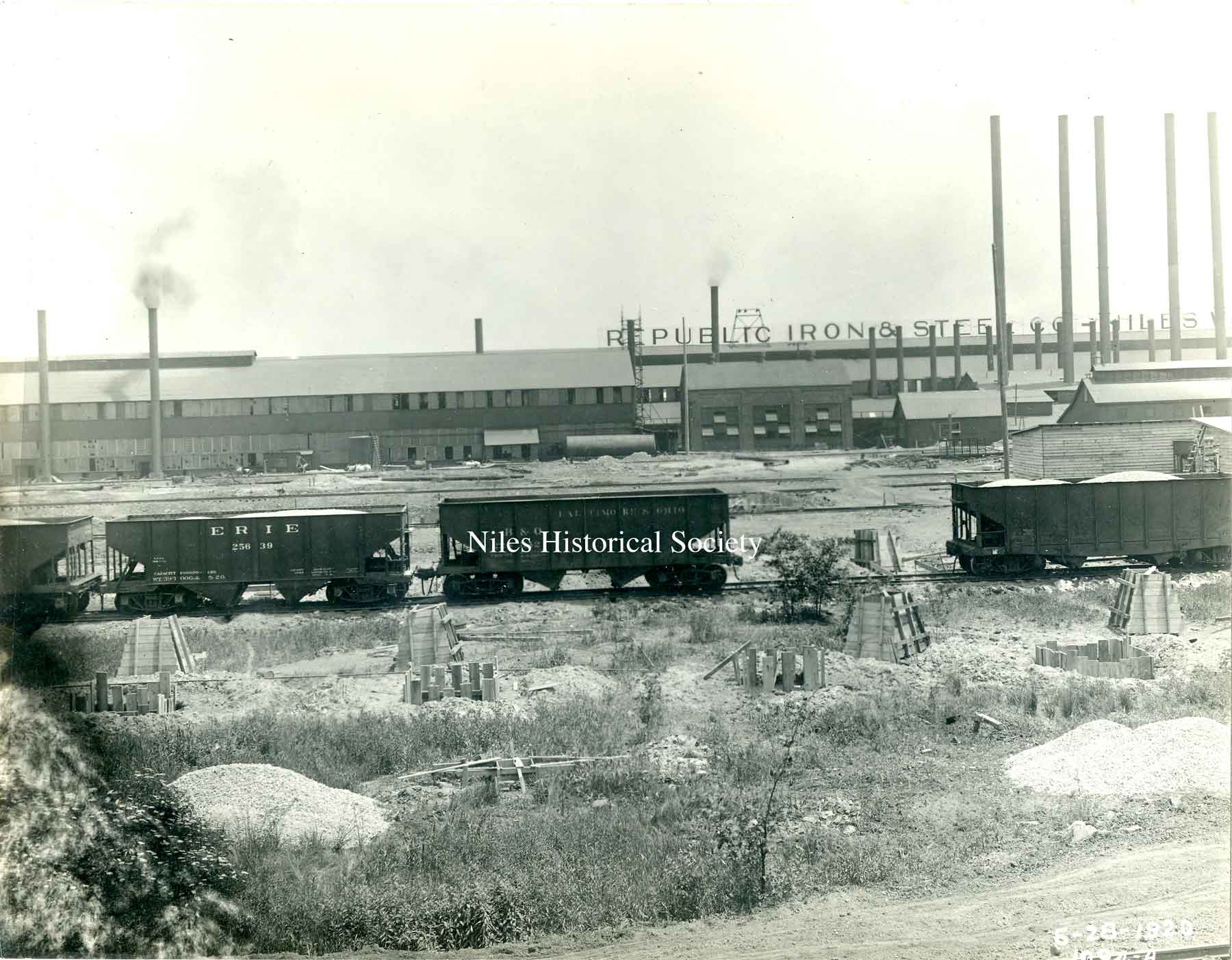
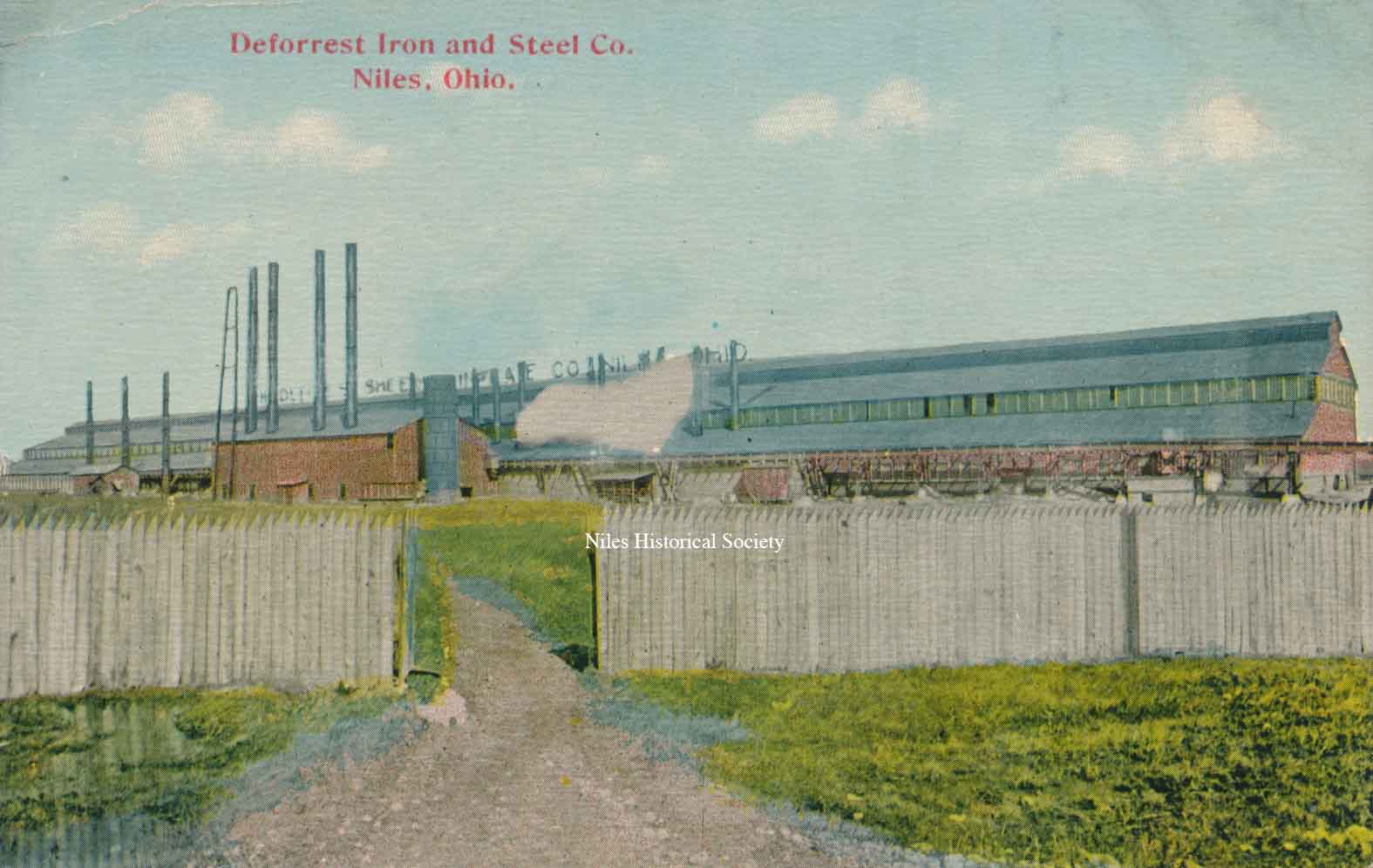
The DeForest Sheet & Tin Plate Company was built in 1915 on the west side of North Main Street at the outskirts of town. It was sold to Republic Steel Company in 1919 and was still a working plant in 1976 when the Directory was published. The three images below show the expansion of the Republic Iron & Steel mill in 1920. |
|
 |
PO2.190 |
PO2.195 |
PO2.188 |
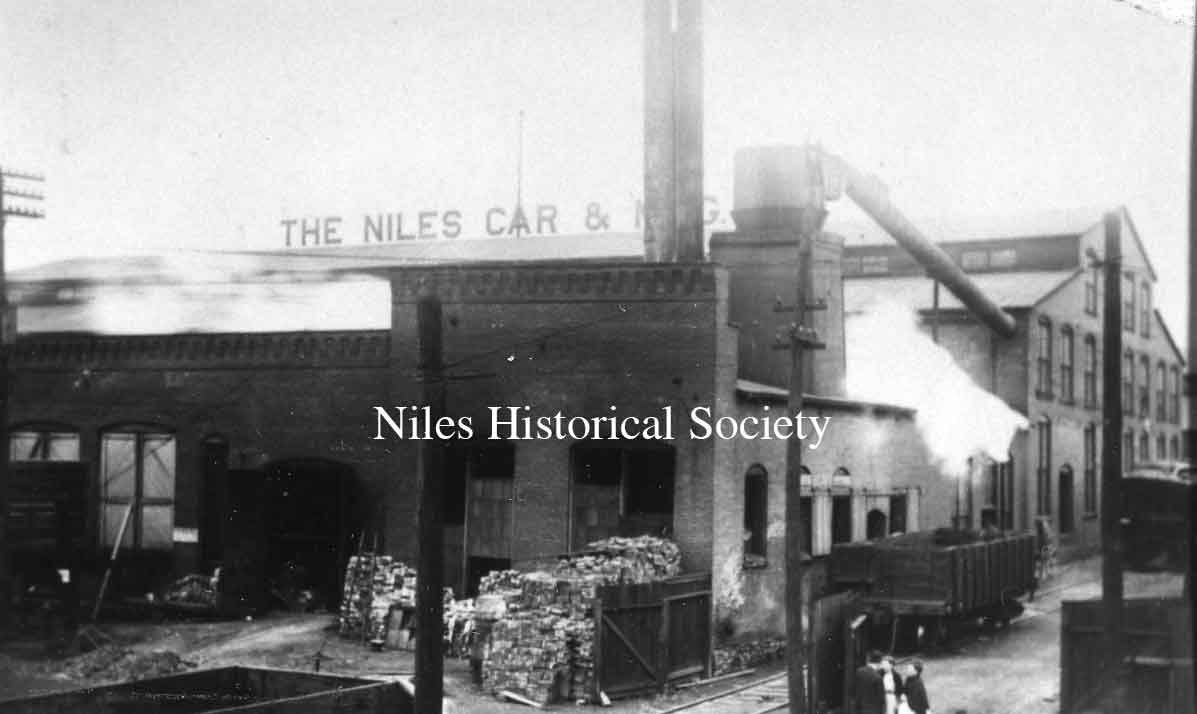
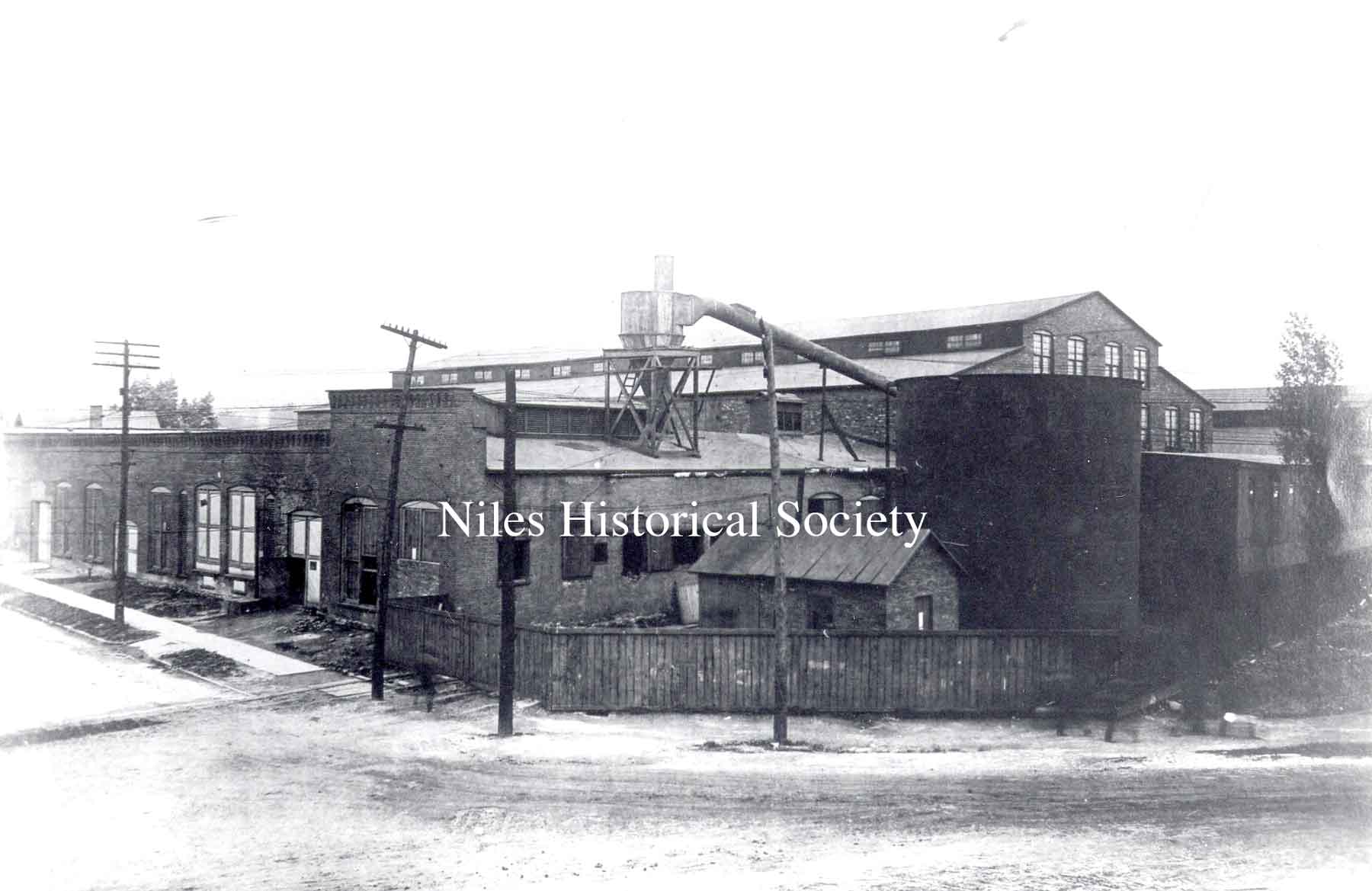
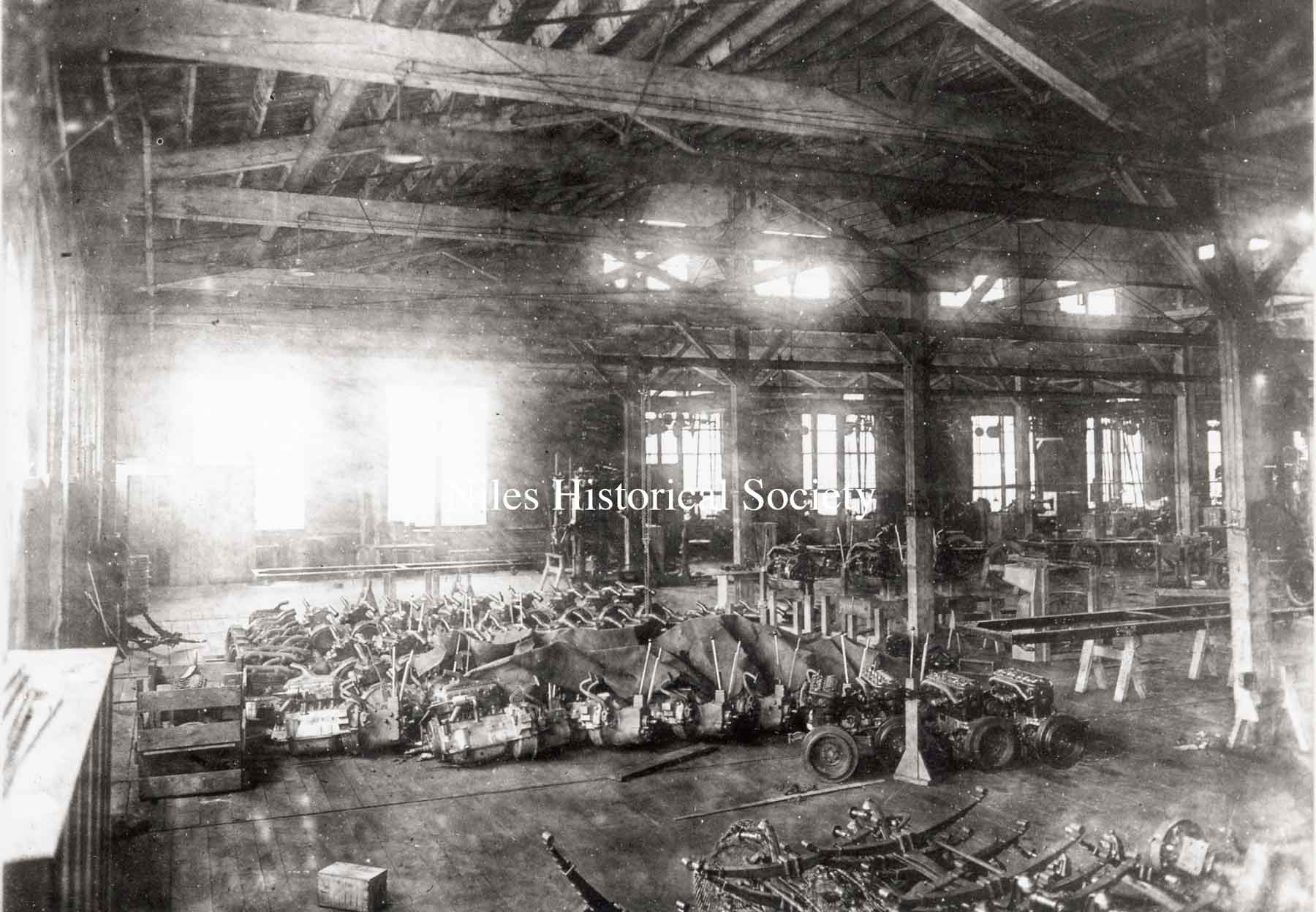
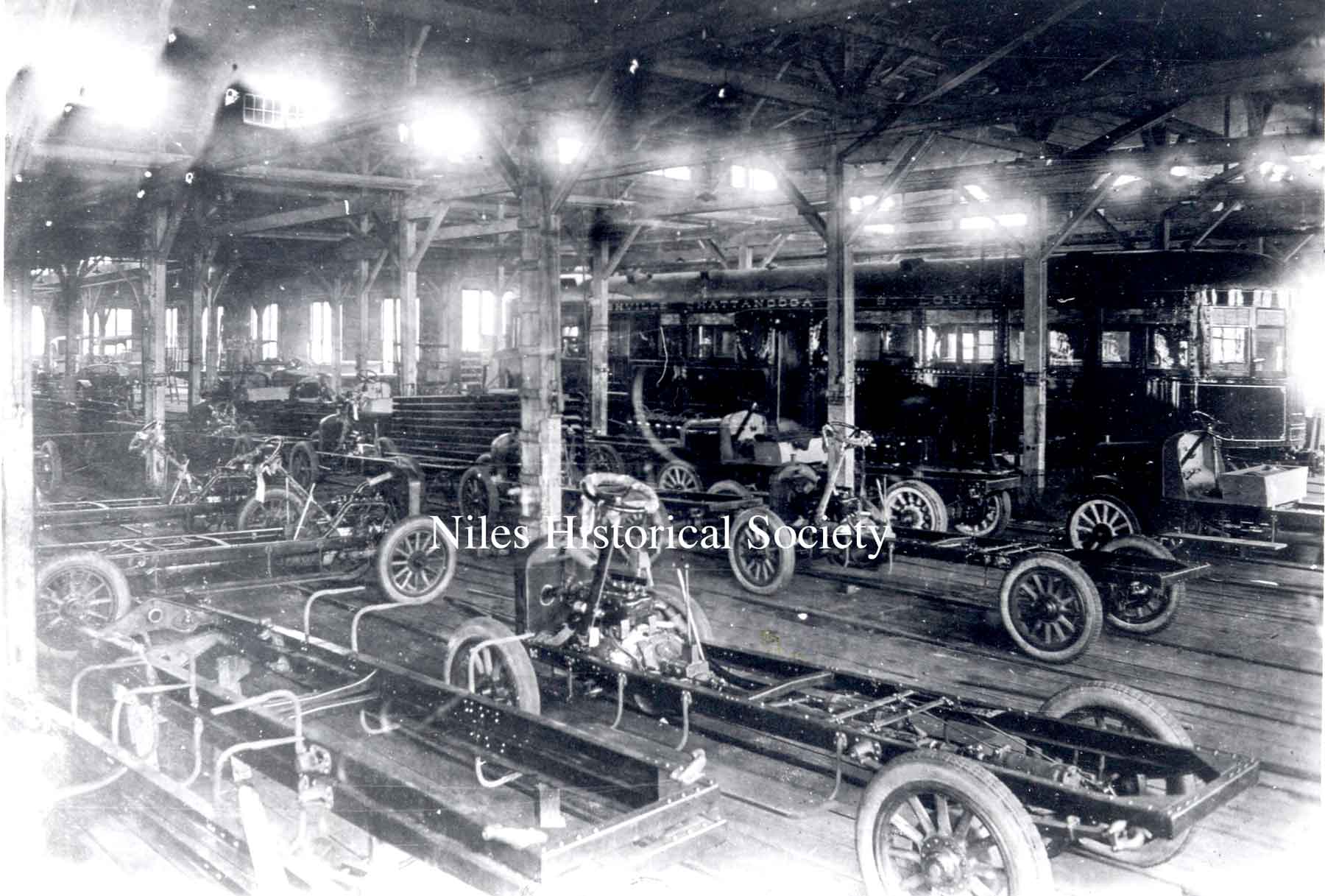
| Erie Street view of the Niles Car & Manufact-uring Company built in 1901, makers of one of the finest lines of plush electric cars of the area. In 1917 the production was shifted to truck chassis. During WWI, the company became Engel Aircraft, manufacturing components for airplanes. It later became Stevens Metal Products and today is the home of the Cleveland Container Corporation. |
This building was located on the block bounded by Erie, South Cedar, Allison Avenue and Mason Streets. PO1.1580 |
The “Northern”, the most noted car built by the Niles Car and MFG. Company, was built in 1901 for magnates Everett and Moore of the Northern Ohio Traction and Lighting Company. It was fifty-three feet long, eight feet six inches wide, twelve feet high, and weighed 54,900 pounds. PO2.8 |
Niles Car & Manufacturing Company was built in 1901 on Erie Street in Niles. PO1.1532 |
Assembly line of truck chassis at the Niles Car & Manufacturing Co. PO1.1530 |
Inside the Niles Car & Manufacturing Com-pany about 1915 when the streetcars were being phased out and truck chassis were being built. Note the Nashville, Chatanooga & St. Louis interurban car in the background. PO1.1454 |
|
Of the many diversified industries in Niles just after the beginning of the twentieth century, the Bradshaw Pottery Company, which provided employment for approximately 200 people, ranked high in the industrial develop-ment of Niles. Early in 1901, an announcement was made regarding the construction of a pottery.The building was built of brick and tile, 72 feet by 400 feet. Only the latest and most improved machinery was used and the highest skilled laborers were employed in producing good quality earthenware. By late October of that year, the Bradshaw Pottery was in full operation, producing tableware with decal styled decorations. However, by 1910, the Bradshaw China Company was in receivership. Frank A. Sebring purchased the company and renamed it ‘The Tritt China Company” a subsidiary of the Sebring Pottery Company in 1912. PO1.510 |
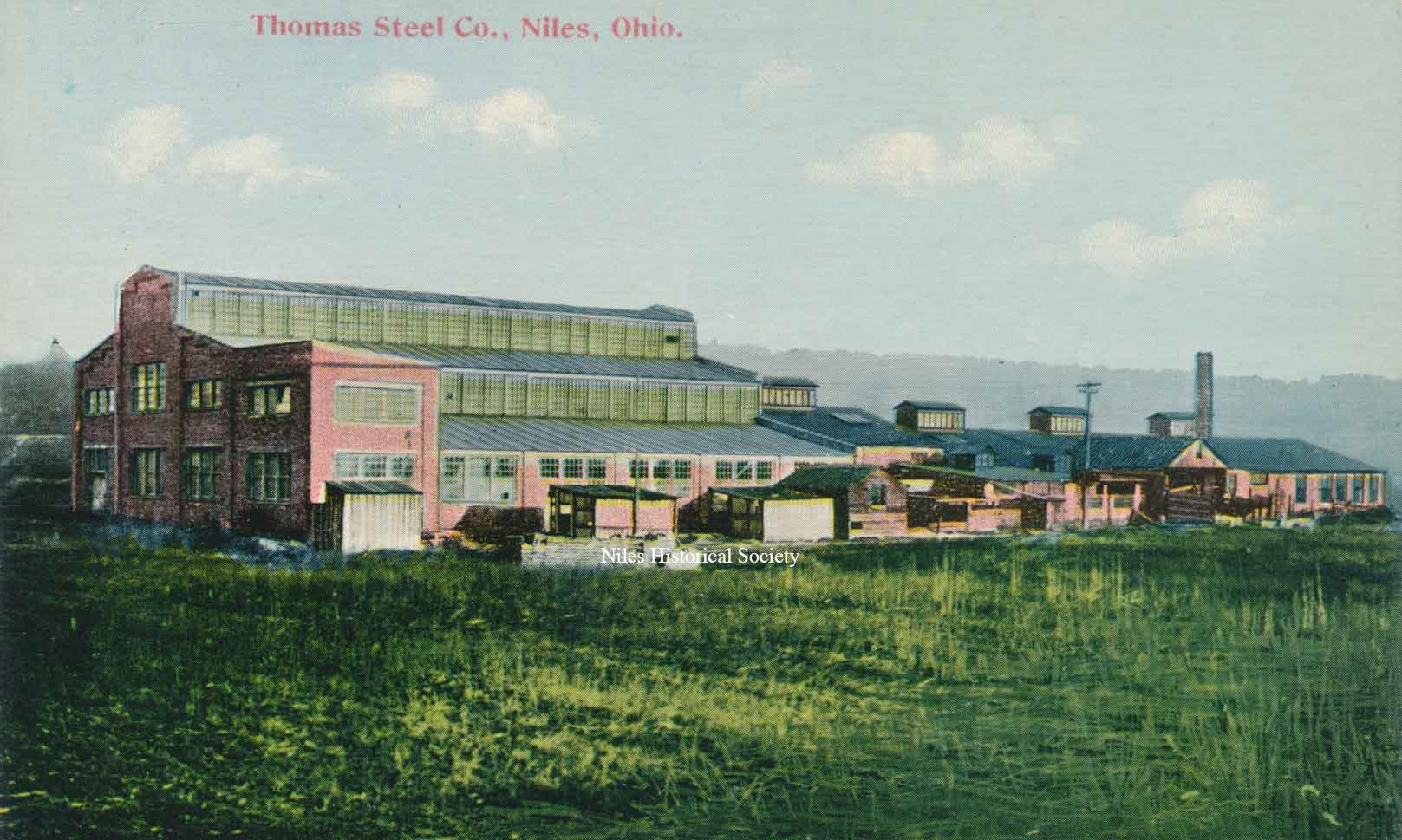
Thomas Steel Mill was a new rolling mill established by W. A. Thomas in 1902. It was located on Walnut Street and was dismantled during the 1930 Depression.
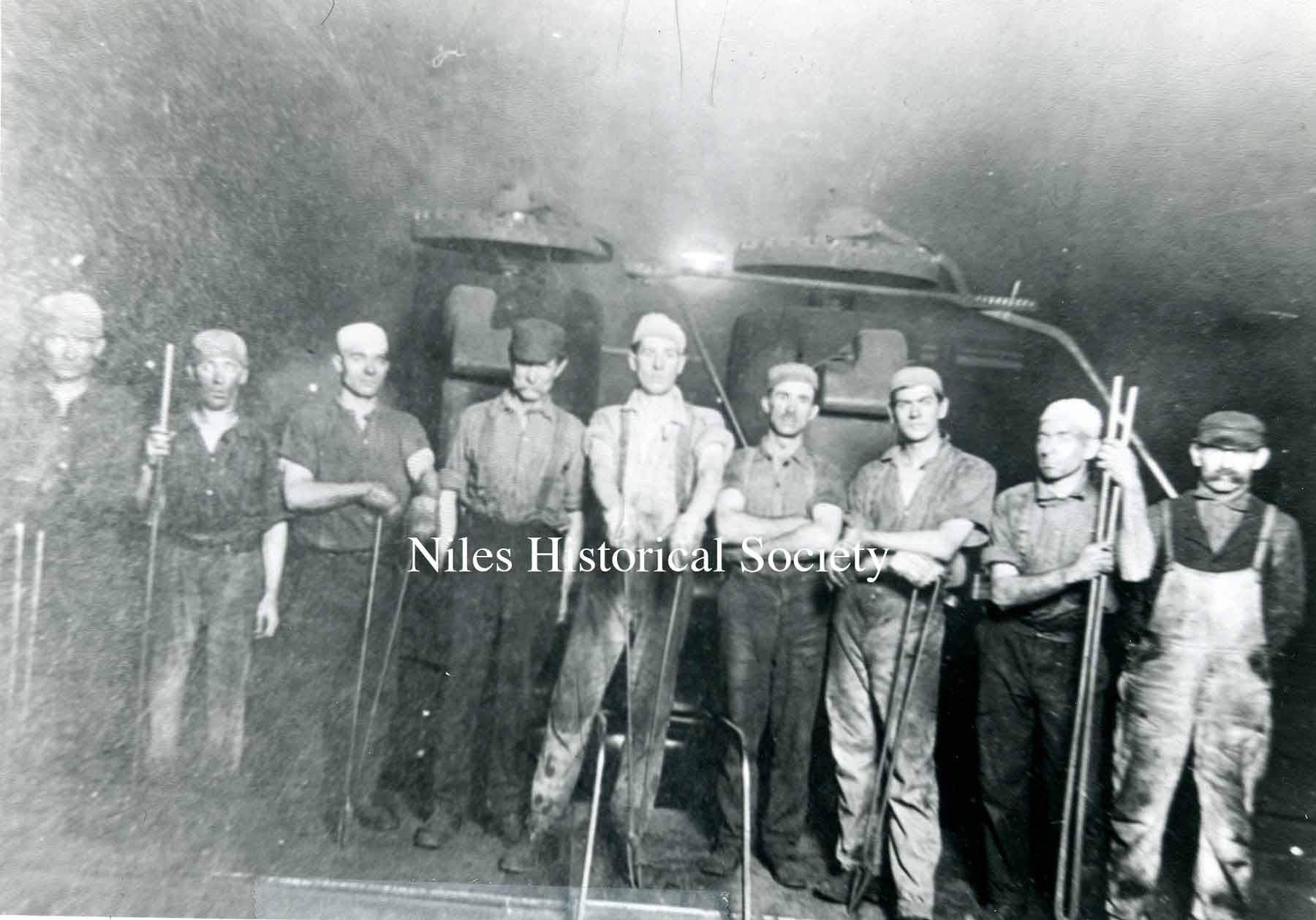
The crew of the Thomas Mill in 1903. PO1.629 |
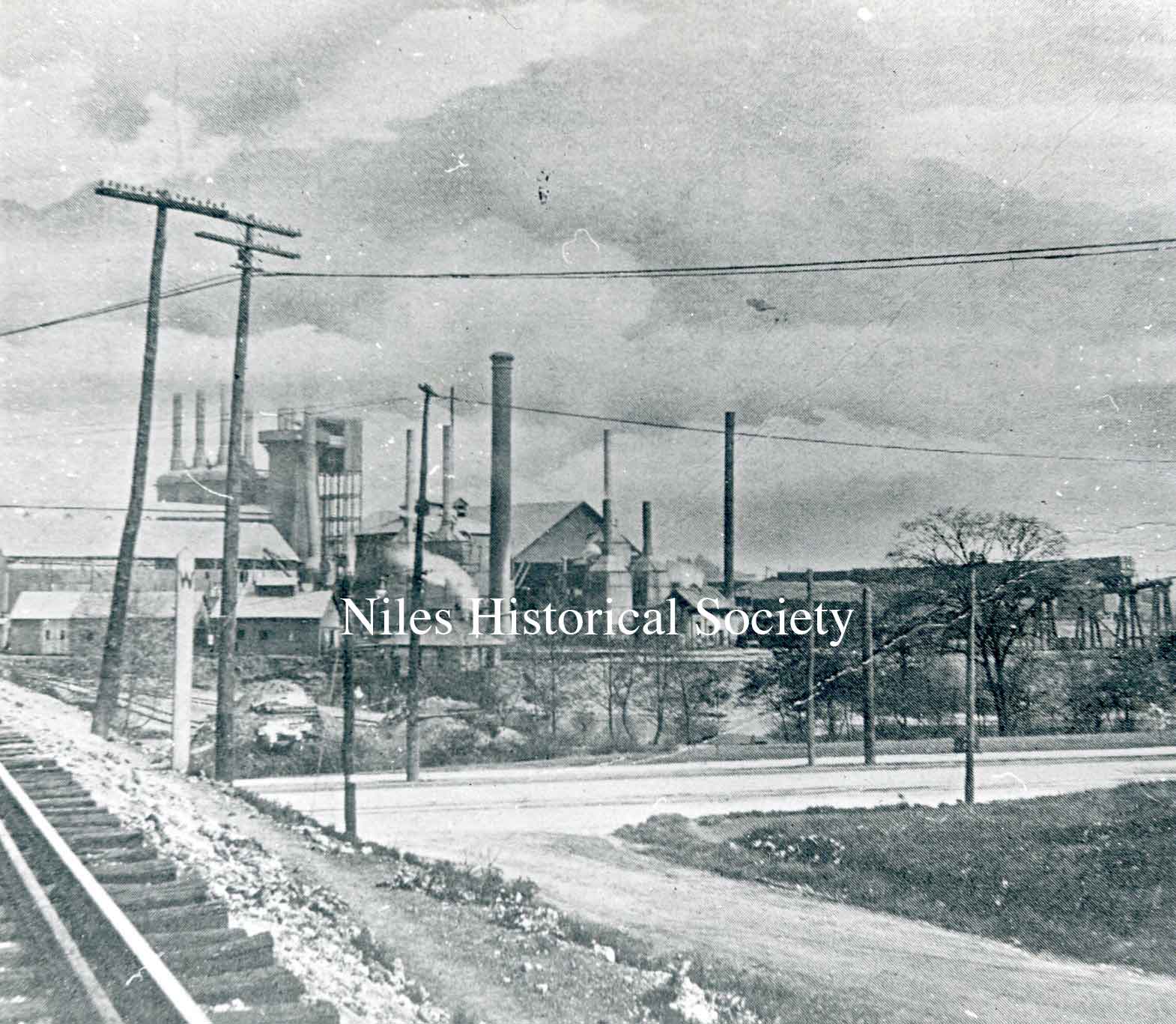
This picture shows Carnegie Steel Co. furnace as it was before being dismantled in 1925. It was located on the east side of Mosquito Creek, south of the Erie RR. The dirt road seen in picture was Robbins Avenue Extension to Main Street, the paved road was East Church Street. PO1.511
|
|
|
||