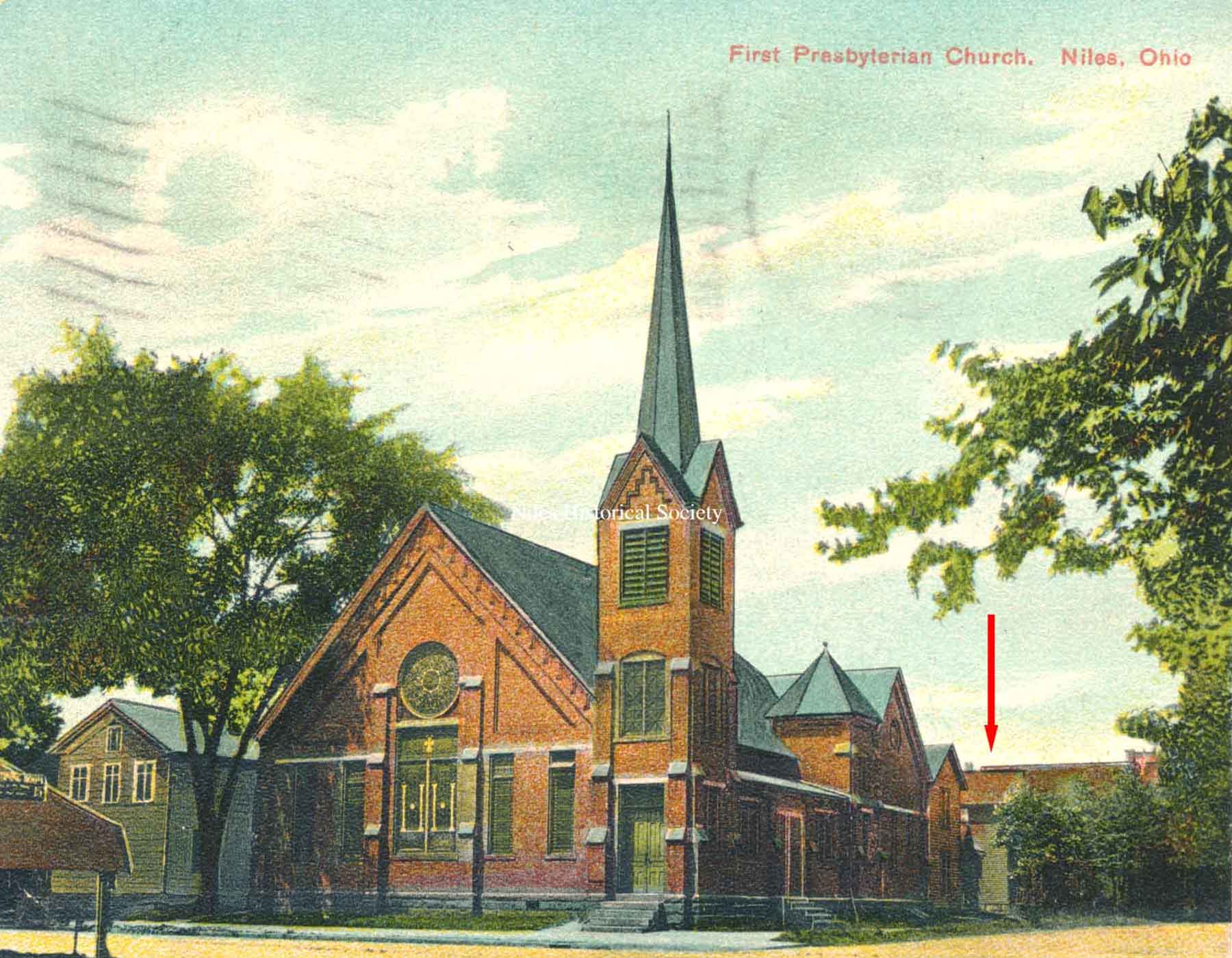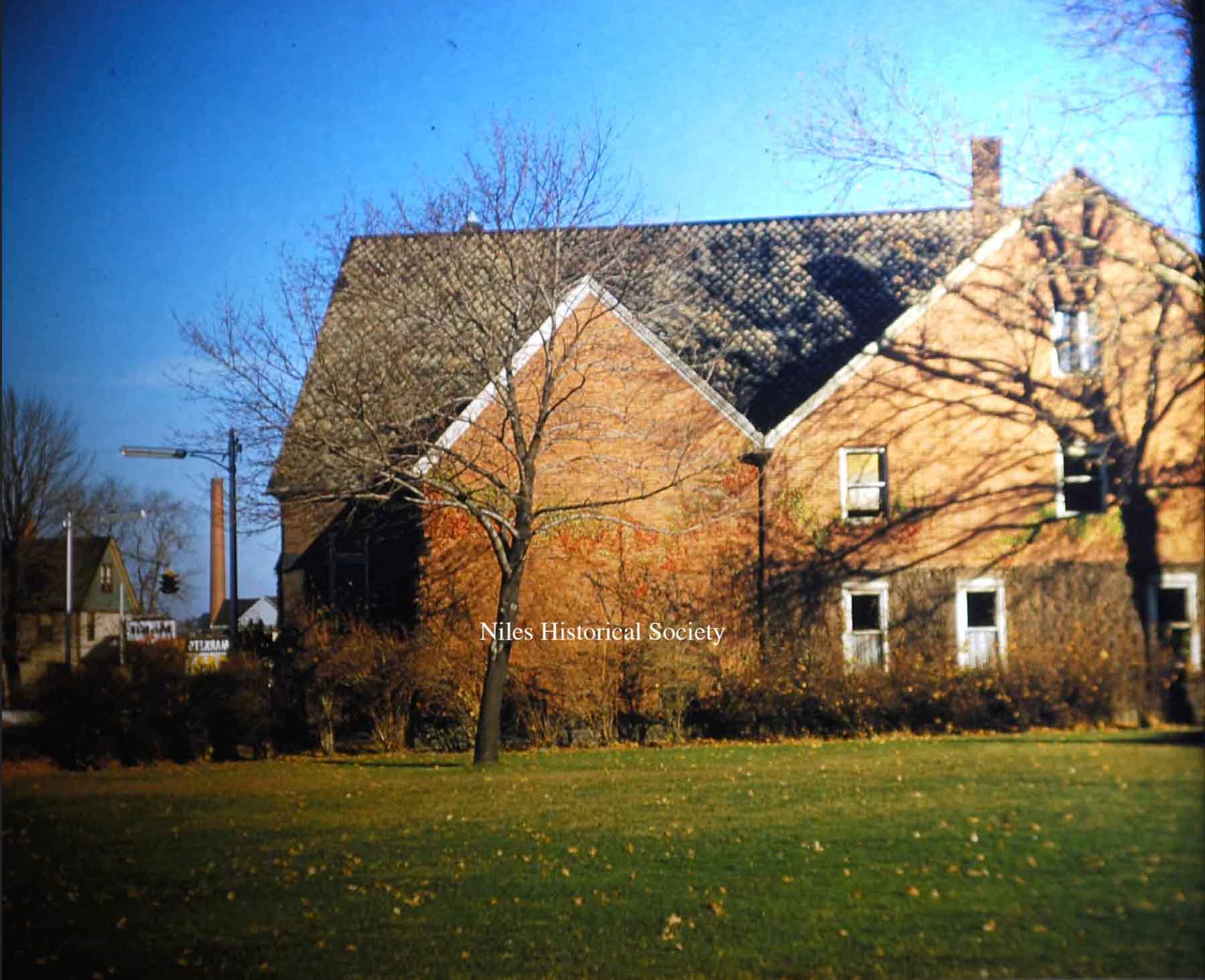


Location of Little White Schoolhouse

Little White Schoolhouse was located
behind Presbyterian Church lot.
Ed: In 1852, the McKinley family
moved from Niles to Poland, Ohio, so that their children could
attend its better schools. William Jr., seventh of nine children,
graduated from Poland Seminary in 1859 |
School
Life in Days of William McKinley
From 1934 Centennial
A more efficient school system resulted from the
rapid growth of industry and population in the late 1840s. The
oldest document sin the possession of the Niles Board of Education
were composed by William McKinley, Sr., father of the
president, who for several years after 1842 was school clerk.
The only school in the village at that time was the little white
schoolhouse, and attendance there was not mandatory.
Teachers were required to pass the county examinations and
were hired for terms of from two to five months. Men teachers
received a salary of about ten dollars per month in money and
one hundred pounds of iron. Thus, in 1842, the district school
clerk wrote:
“Hired A.J. Luse for the term of two months,
commencing December 27, 1842, for which he was paid ten dollars
per month out of the school funds and one hundred pounds of
iron by collections.” – Wm McKinley
At first, the average salary for women teachers was six dollars
per month, half of which was paid in money and the other half
in trade to be collected from parents in proportion to the number
of children attending. By the time of the Civil War, however,
teacher’s salaries had increased and were on a more systemic
basis. The record shows that on April 8, 1867, Andrew Dienst
was hired for three months at $65.00 per month. Olive Allison
for three months at $40.00 per month and Hasey Hardman for three
months at $35.00 per month.
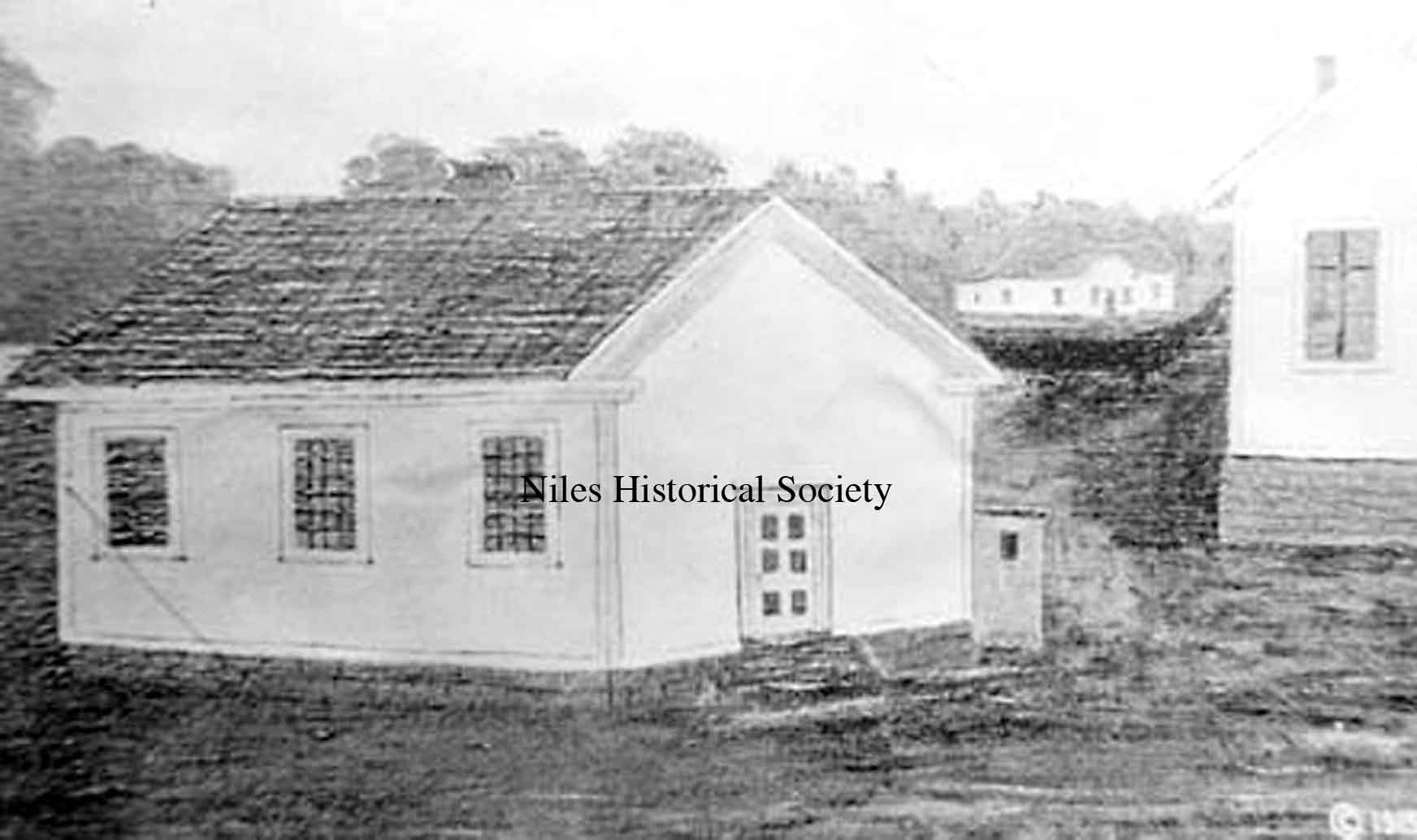
When William McKinley attended the small frame schoolhouse
which stood at the rear of the present Presbyterian church,
three teachers, two ladies and a man, taught in the one large
room. The man was considered the principal. McKinley was then
only a small boy; among the larger boys were Joseph G. Butler,
Jr., James Ward, Jr., and Miles Butler.
A typical report, submitted by the teacher, gives an idea of
what the school must have been like:
“Report of the school kept by District No. 8, Weathersfield
Township, for the term commencing November 3m 1846 and ending
the 17th of April 1847, six months Number of scholars enrolled
was 112, of which 56 were males and 56 females. The number in
daily attendance 59. Branches being taught being writing, Geography,
arithmetic, grammar, philosophy, and algebra.”
By A. Sanford, teacher.
|
|
| 
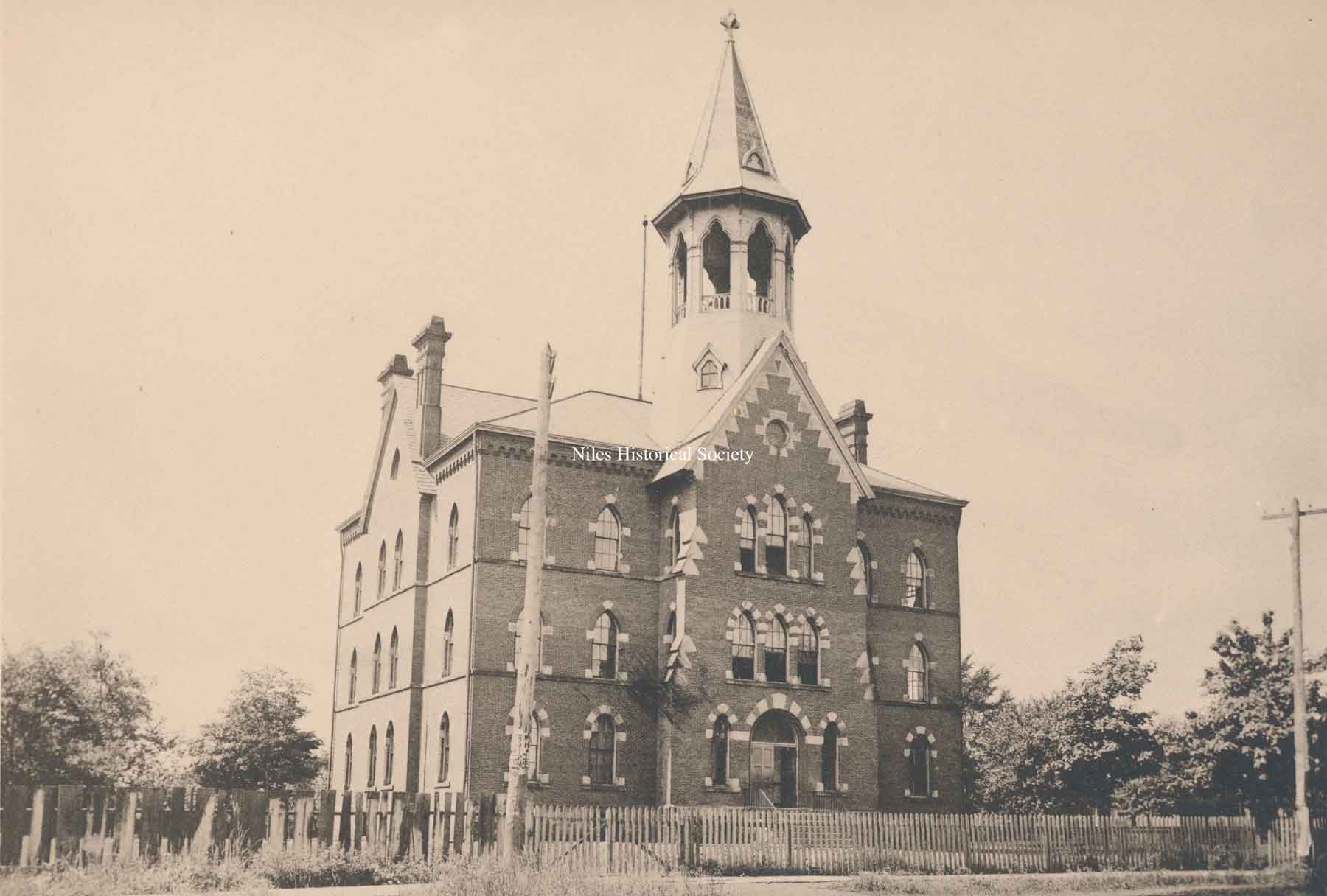
Central Schoolhouse

Little White Schoolhouse |
Development
Of Niles School System From 1871 Until the Present Time.
Six Teachers In 1871; Four Schools Here In 1890.
Schools occupied and important place in the community life following
the creation of the Union School District and the completion
of the Central Building in 1871. The increase of the school
population soon required that a capable superintendent and school
staff be hired and that a more adequate school term be provided.
Six Teachers
When the Central school opened in 1871 there were, for that
building, six teachers and a principal. A school report in the
Western Reserve Chronicle in 1876 indicated that at that time
there were two schools in Niles, valued at $40,000.00, and that
the school staff totaled ten. The first extensive school report
after 1871 is dated 1889, the first year of Superintendent Roller’s
twenty-two-year administration.
Staff Increases
In that year the school force consisted of fifteen teachers
and the superintendent; 901 pupils were enrolled for a term
of thirty-six weeks, but the average attendance was only 85%
of the enrollment.
|
|
| Enrollment
Grows
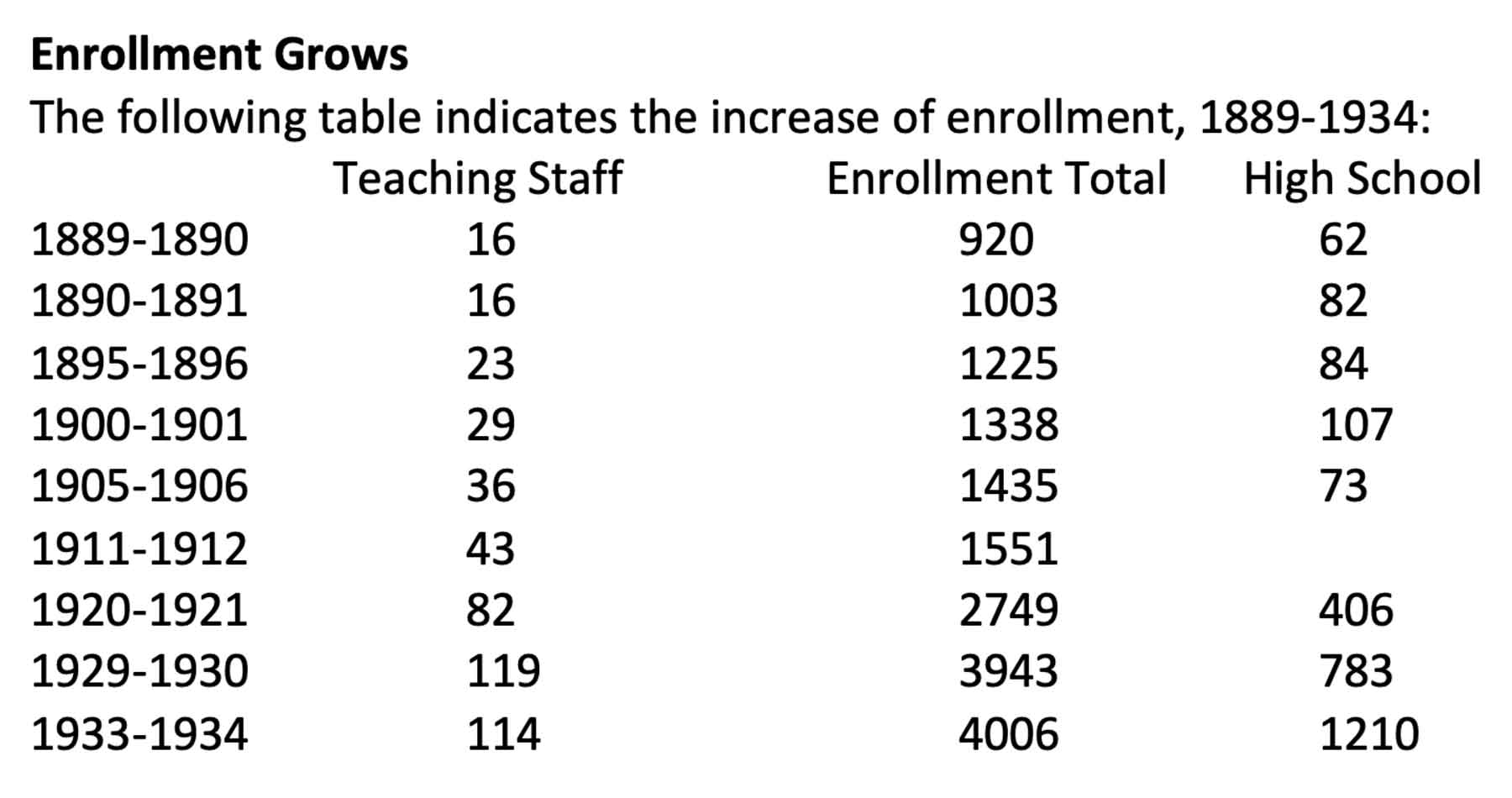
The following table indicates the increase of enrollment, 1889-1934:
The above table indicates that school enrollment
increased gradually until 1912, since when it has increased
more than 195%.
The largest proportionate increase has occurred
at the high school, where as late as 1906, the enrollment was
but 78, and the largest graduating class 18 in number, as compared
with a high school enrollment of 1210 and a graduating class
of 181 in 1834.
|
|
|
| 
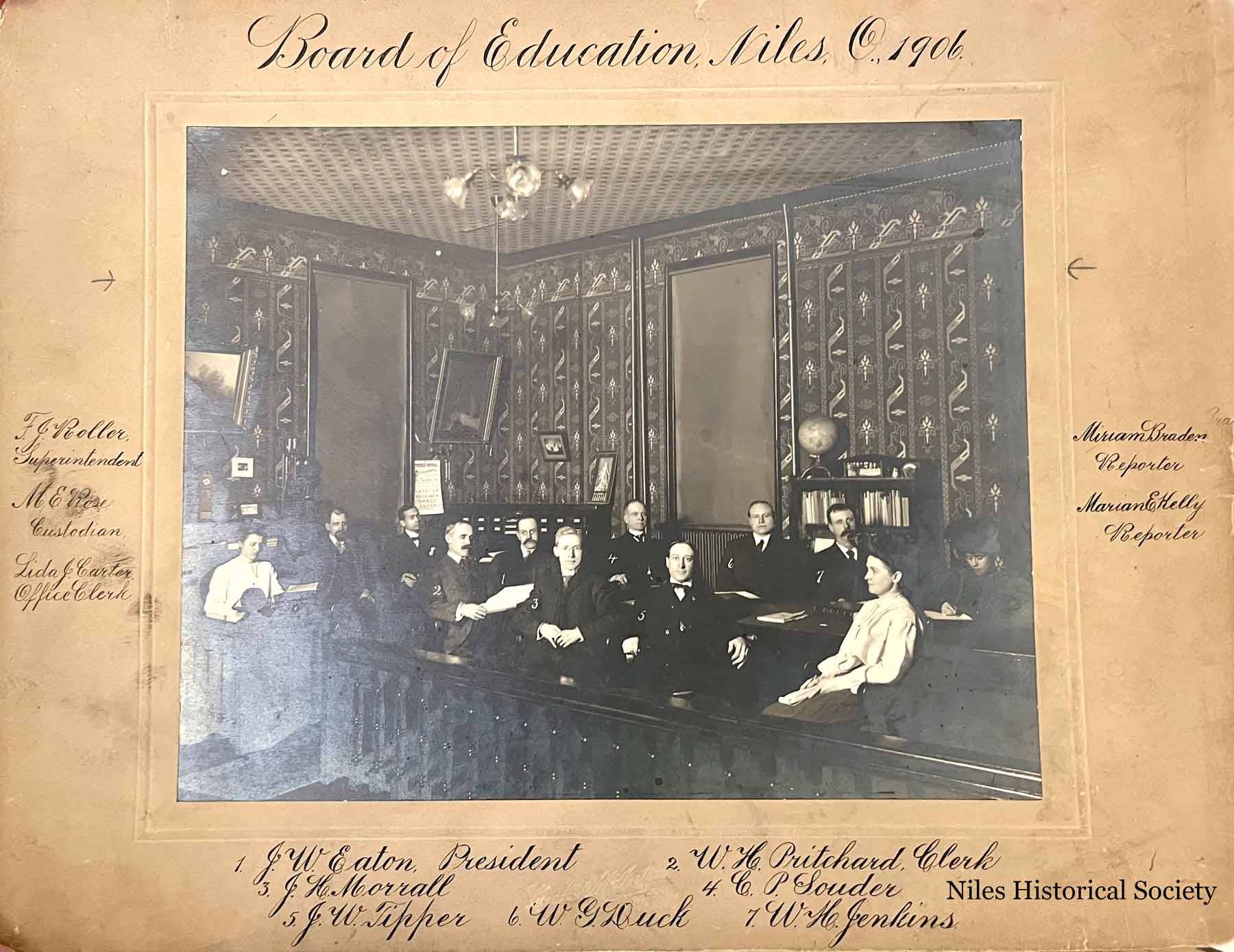
1908 Niles school board members
|
4 Schools in 1890
To provide for this increasing enrollment has been one of the
difficult problems school boards and superintendents have had
to meet. In 1890, four school buildings were in use: the Central
building, the old wood school on Leslie Avenue, a two-room school
on Walnut Street and a two-room structure on the South Side.
5th School Added
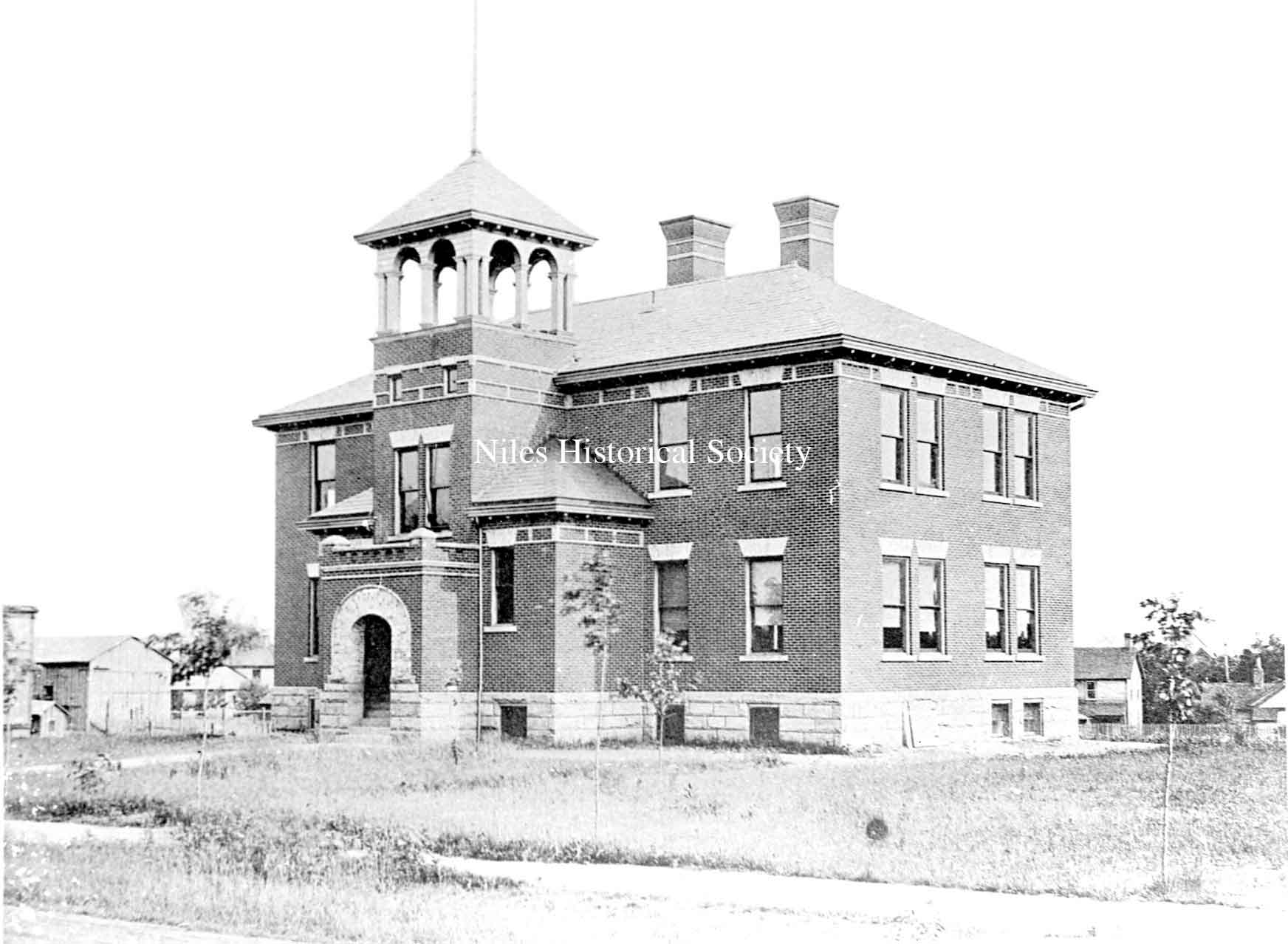
In 1891 the brick school on Leslie Avenue was added, and at
various times for short intervals before 1905, schoolrooms were
provided as follows: Bert Stree-1 room, 1896-1897; First Street-1
room, 1900-1905; and Park Avenue- 1 room, 1905-1905. Of all
of these schools, only the Leslie Avenue building remains and
it is no longer school property.
|
|
| 
|
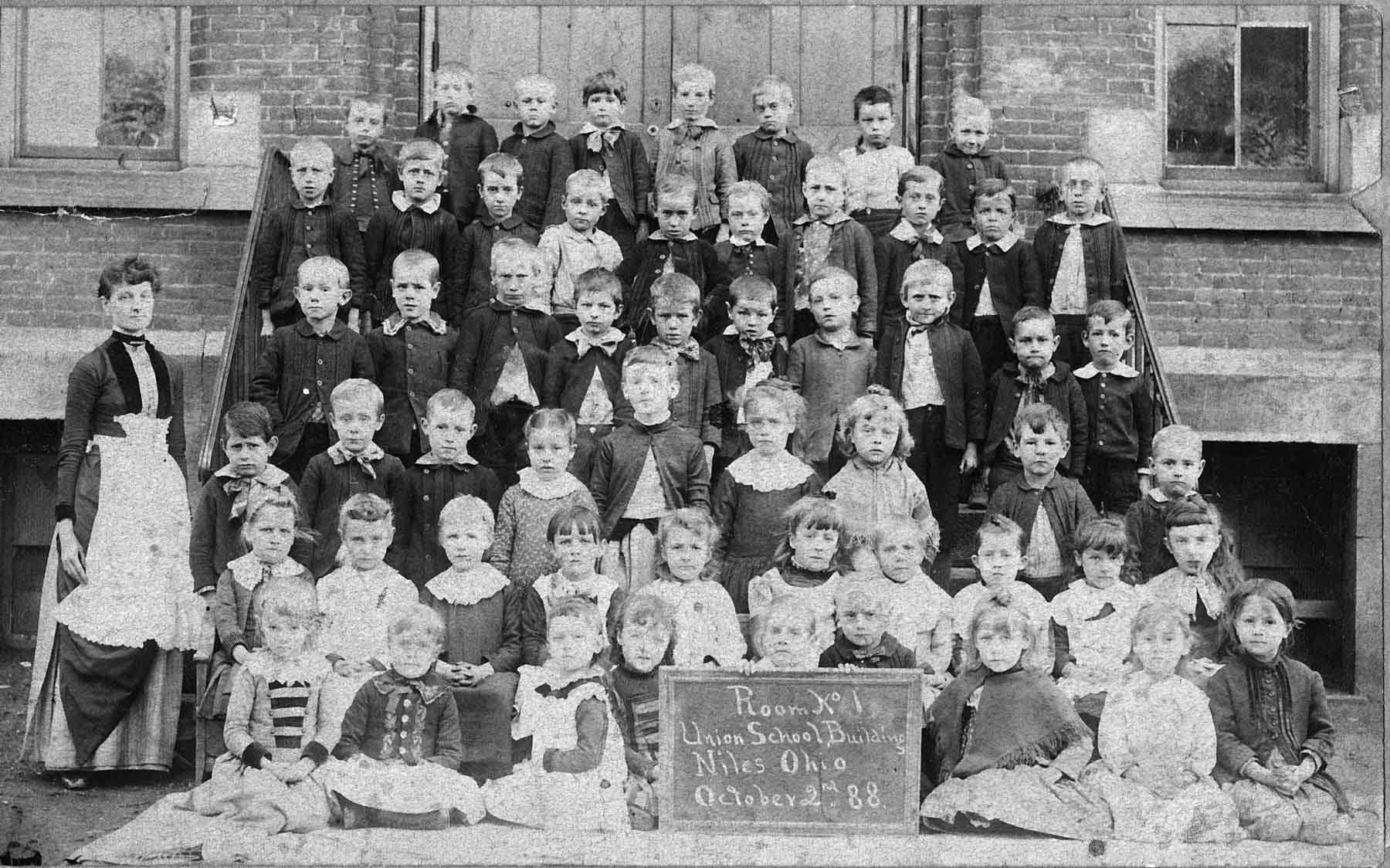
Left:
Room 1
Union School (Central) Building
October 2, 1888
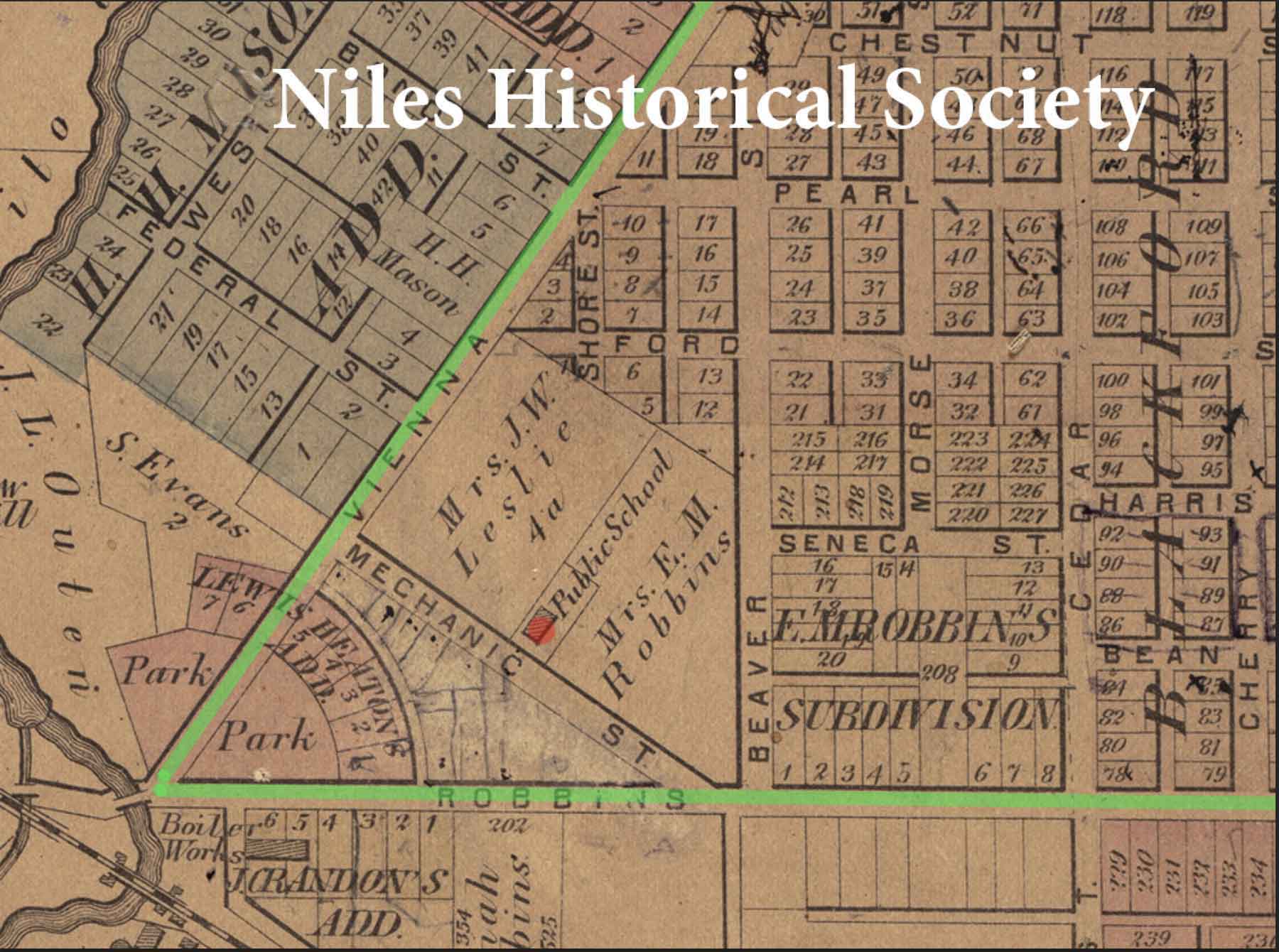
Right:
Location of Leslie Avenue School
Mechanic Street renamed Leslie Avenue
Mrs. J.W. Leslie, property owner
|
|
|
| 
Jackson
School on Warren Avenue

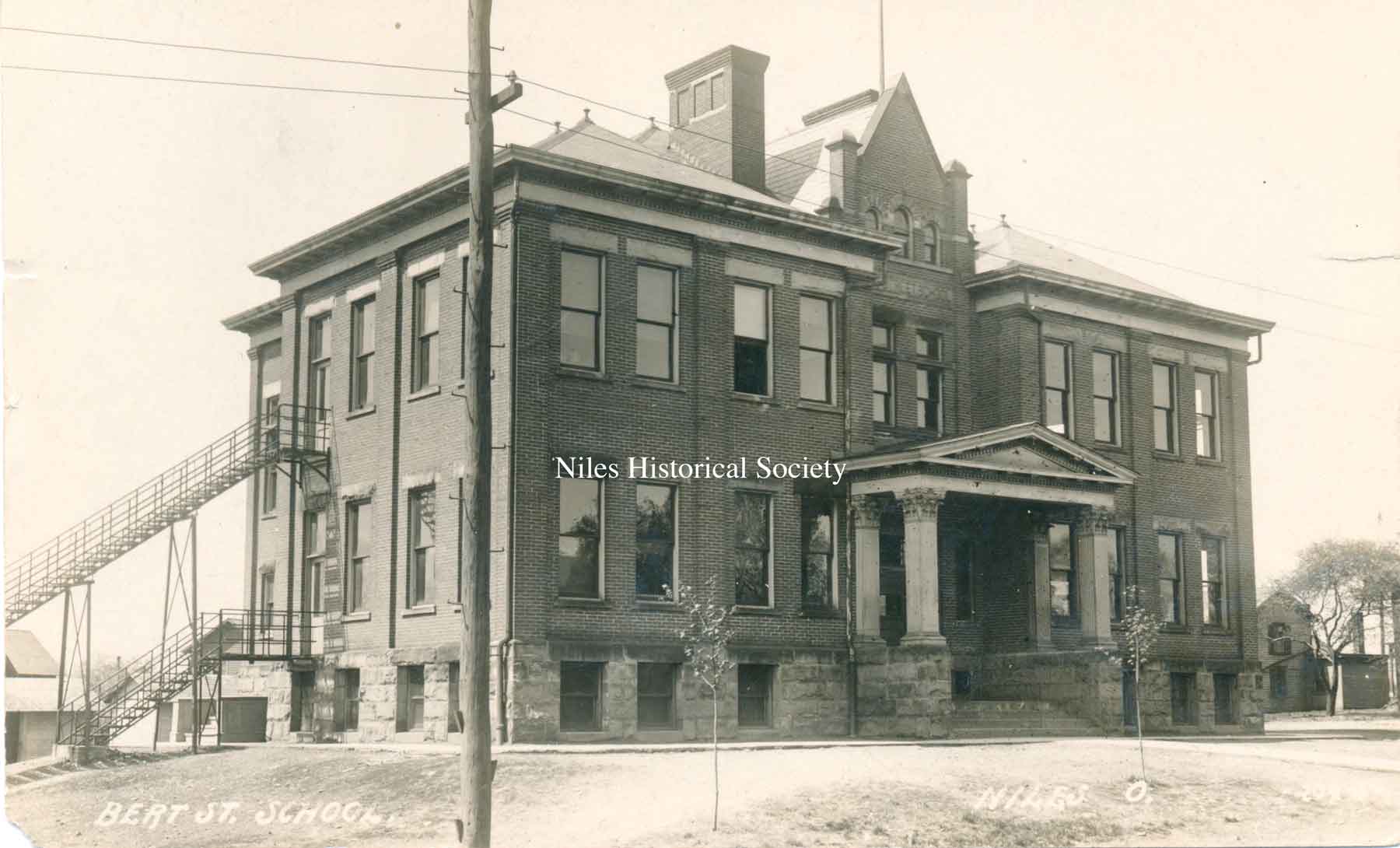
Bert
Street School on Belmont Avenue

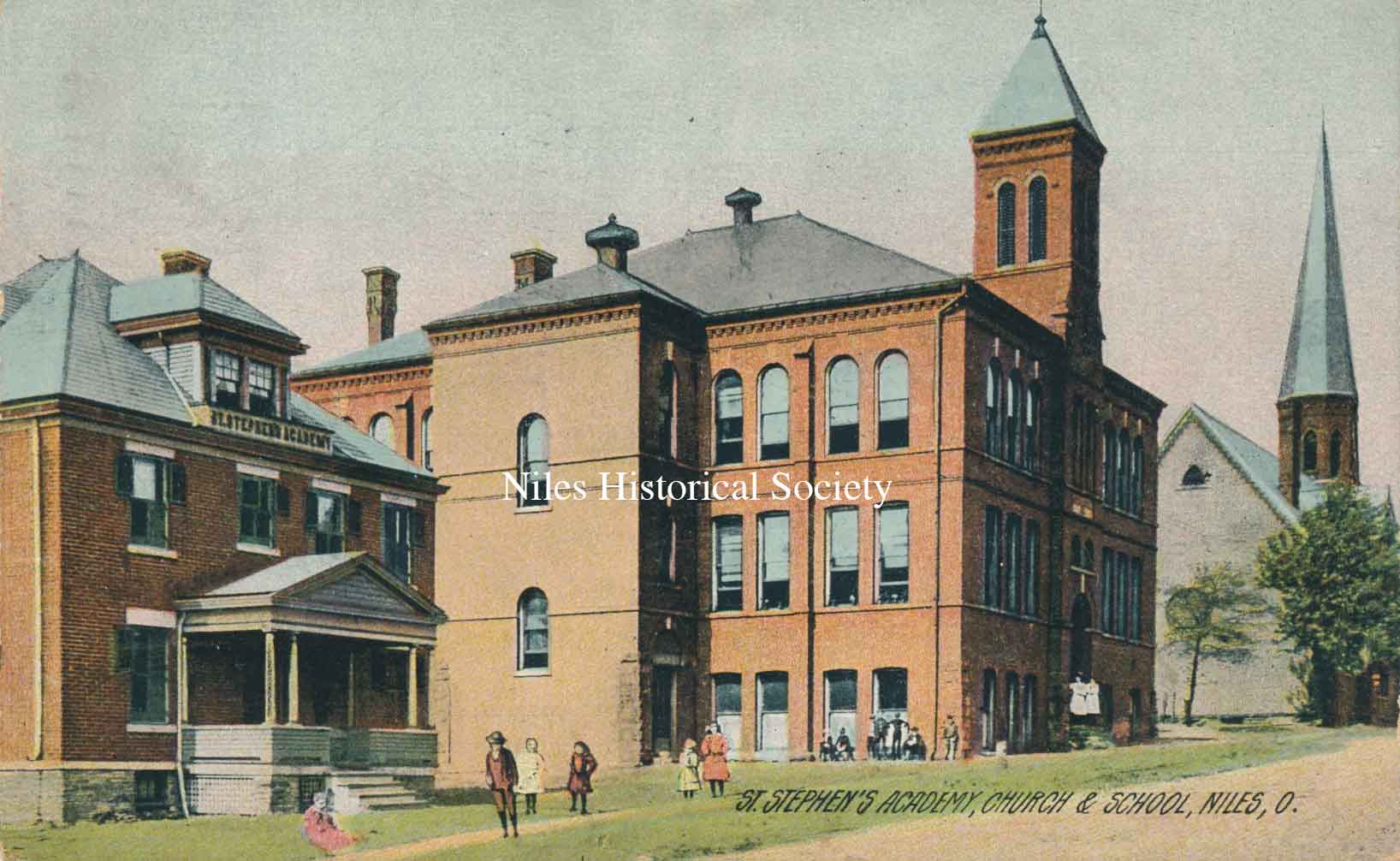
St.
Stephen School |
Present Niles Schools
The public school buildings now in use and the dates of construction
are: Jackson, Warren Avenue-1893 (enlarged 1911); Lincoln, Cedar
Street-1896 (enlarged 1905); Monroe, Bert Street-1905; Garfield,
Third Stree1905; Jefferson, South Bentley Avenue-1911 (enlarged
1913, 1925);McKinley High School-1914; Roosevelt, Madison Avenue-1919;
Washington Junior High, Hartzell Avenue-1924; Harrison, McKinley
Heights (acquired as addition to school district-1920); Administration
Building, Church Street-1930. In addition to the public schools,
the St. Stephen Parochial school, built in 1901, provided for
480 pupils in 1933-1934.
Modern Curriculum
The period 1874-1934, saw the evolution of the modern curriculum,
with most of the changes coming after 1900. Before that date
the work in the upper elementary grades consisted of reading
(from McGuffy), writing, arithmetic, spelling (from Harvey)
and geography. The only innovation was the introduction in 1891
of United States History. The early high school curriculum included
business arithmetic, algebra, and plane and solid geometry,
two years of rhetoric and one of literature, two years of Latin,
and for parts of a year: botany, physiology, physical geography,
Physics, English history and ‘science of government’.
The first addition was bookkeeping in 1891, and ten years later:
music, drawing, writing, and German was added. The remainder
of the modern curriculum and recognition of extra-curricular
activities came later.
Interests Differ
The interests of pupils in the earlier part of the period seem
rather remote from those of today. Literary societies aroused
great interest and frequent debates, recitations and essay writing
contests were held. At one of these programs described in the
‘Trumbull County Independent’ in 1886, thirteen
pupils read Whittier’s ‘Snowbound’ from memory
before three judges; a vocal solo was interspersed between every
second number.
Sometimes, however, the program was of a social
nature as when on January 1, 1886, the literary society entertained
at a social held in the Falcon skating rink. The literary programs
were good preparation for graduation, as each member of the
graduating class was expected to give a commencement oration
upon some patriotic or other lofty subject
It was an age when reform movements, dissipated
by the Civil War, were again gathering strength. In 1886, the
entire school population ‘took the pledge’ in writing,
to abstain from use of tobacco or liquor, and to cultivate ‘clean
and pure living.
|
|
|
|
|